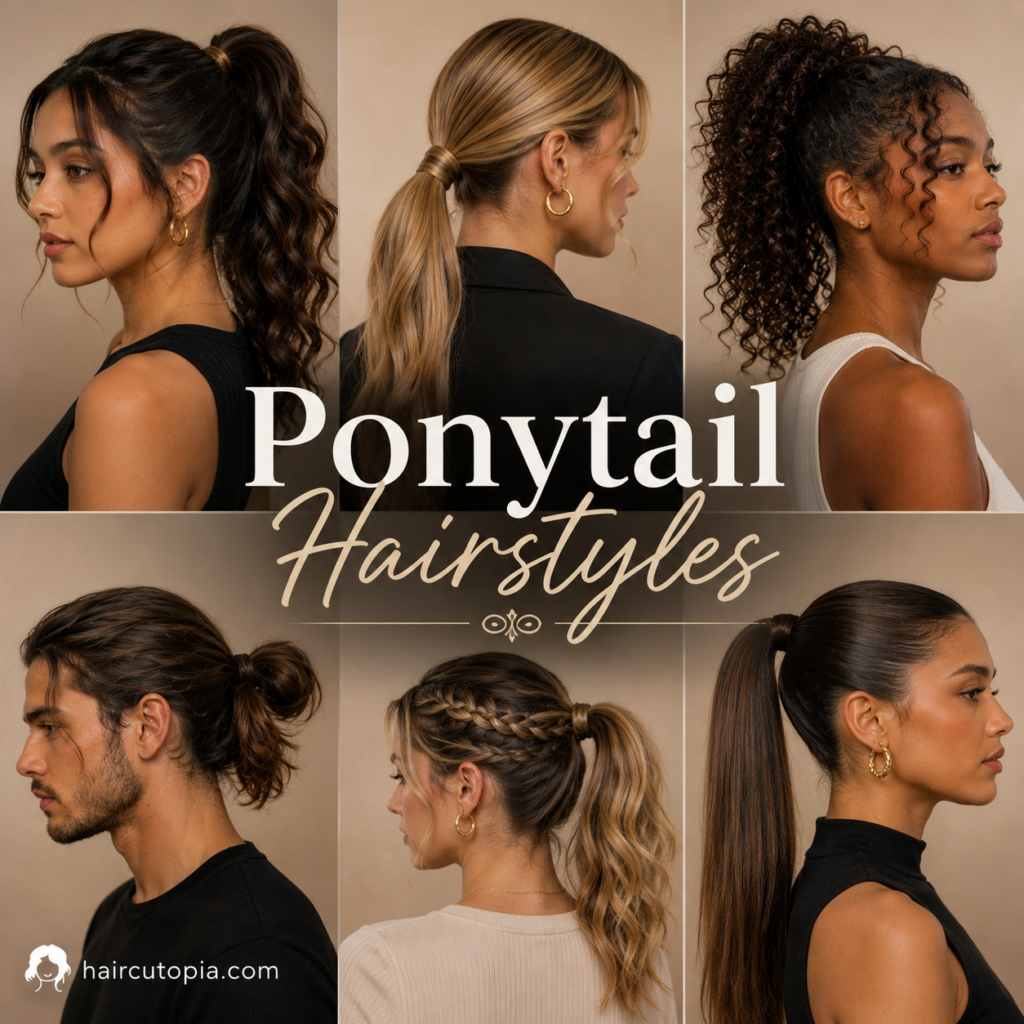
The ponytail might be one of the simplest hairstyles ever invented, but simple doesn’t mean limited.
Move it higher and the whole style changes. Wear it low and sleek for something more polished. Add curls, waves, braids, or natural texture and a basic ponytail suddenly has much more personality. Even wrapping a small piece of hair around the elastic can make an everyday style feel finished.
That’s why ponytail hairstyles work in so many situations.
They can be practical enough for a busy morning, polished enough for work, and elegant enough for weddings, prom, and other formal events. They also work across a wide range of hair textures and lengths, although the finished shape will naturally look different from one person to another.
Whether you want something quick or you’re looking for a more elaborate ponytail, there are plenty of ways to make this familiar hairstyle your own.
Why Ponytail Hairstyles Are So Versatile
At its simplest, a ponytail gathers the hair and secures it in one place.
Everything else is adjustable.
You can change:
- The height
- The part
- The amount of volume
- The texture of the ponytail
- The smoothness of the roots
- The placement
- The accessories
- Whether braids or twists are incorporated
- How tightly or loosely the hair is gathered
Those small changes can take a ponytail from casual to formal without changing the basic structure.
Ponytails also keep much of the hair controlled while leaving the length visible, making them a useful alternative when you don’t want a full bun or updo.
Popular Types of Ponytail Hairstyles
Most ponytail variations begin with the same basic technique but create very different silhouettes.
High Ponytail
A high ponytail sits around the crown or higher.
This placement creates lift and allows the hair to fall from a more elevated point, which can make the ponytail appear especially full and energetic.
The lengths can remain:
- Straight
- Wavy
- Curly
- Coily
- Braided
High ponytails work particularly well when you want the hairstyle itself to be a noticeable part of the look.
Low Ponytail
A low ponytail sits near the nape.
It tends to create a softer, more understated shape and can easily transition between casual and formal styling.
Wear it with a center part for a clean, balanced look or use a side part for something less symmetrical.
Mid-Height Ponytail
A mid-height ponytail falls between the high and low versions.
It’s a practical everyday placement because it keeps the hair controlled without creating as much lift or tension as a very high ponytail.
Side Ponytail
A side ponytail is positioned toward one shoulder rather than directly at the back.
This allows longer hair to remain visible from the front.
Loose waves, curls, and braids work especially well with this placement.
Sleek Ponytail Hairstyles
A sleek ponytail emphasizes smooth roots and a clean overall shape.
The ponytail itself can remain straight or contrast with the smooth front through curls or waves.
Sleek High Ponytail
A sleek high ponytail combines a tightly controlled base with an elevated placement.
For a more finished appearance, wrap a small piece of hair around the elastic.
Sleek Low Ponytail
A low placement gives the sleek ponytail a minimalist feel.
It works particularly well with:
- Center parts
- Deep side parts
- Straight lengths
- Soft waves
Slicked-Back Ponytail
Instead of creating a visible part, direct the hair backward from the face.
The result can be highly polished or slightly softer depending on the styling product and finish.
A sleek style should feel secure, but it doesn’t need to be painfully tight.
Messy Ponytail Hairstyles
Messy ponytails intentionally preserve softness, volume, and movement.
The key word is intentionally.
A good messy ponytail still has a deliberate overall shape.
Messy High Ponytail
A high ponytail can be loosened around the crown to create volume.
Face-framing pieces can soften the front.
Messy Low Ponytail
A low ponytail works naturally with loose waves and textured hair.
Rather than smoothing everything flat, allow some movement through the roots and lengths.
Tousled Ponytail
A tousled ponytail emphasizes texture throughout the hairstyle.
Natural waves or curls can provide much of that texture without additional styling.
Ponytail Hairstyles for Long Hair
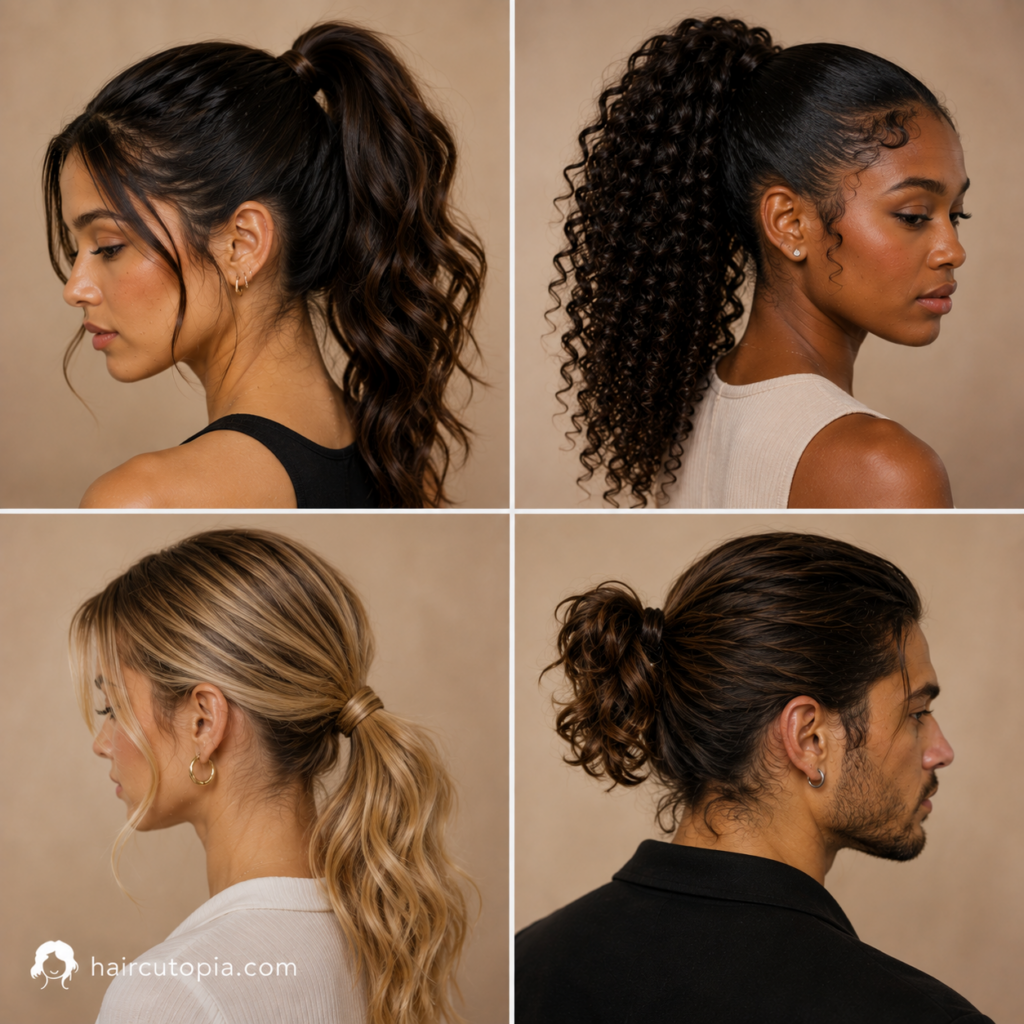
Long hair gives you plenty of room to experiment with ponytails because the length remains visible after the hair is secured.
Ideas include:
- High ponytails
- Low ponytails
- Bubble ponytails
- Braided ponytails
- Side ponytails
- Curly ponytails
- Wavy ponytails
- Wrapped ponytails
- Half-up ponytails
Long hair can also become heavy.
If a high ponytail creates uncomfortable pulling, lowering the placement may reduce some of that tension.
Ponytail Hairstyles for Medium Hair
Medium hair is often long enough for a full ponytail while remaining relatively lightweight.
Try:
- Mid-height ponytails
- Low ponytails
- Small high ponytails
- Half-up ponytails
- Bubble ponytails
- Braided ponytails
- Wavy ponytails
Shorter layers may naturally fall around the face.
Rather than repeatedly forcing them back, you can leave selected pieces loose as part of the style.
Ponytail Hairstyles for Short Hair
Some short haircuts still have enough length for ponytails.
Bobs and lobs may work particularly well with:
- Low ponytails
- Small mid-height ponytails
- Half-up ponytails
- Mini bubble ponytails
If the shortest pieces don’t reach the elastic, pins or clips can help secure them.
You can also leave those sections loose rather than trying to make the hairstyle perfectly smooth.
With very short cuts, a half-up ponytail may be more practical than gathering the entire head.
Ponytail Hairstyles for Straight Hair
Straight hair gives ponytails clean lines and makes the length especially noticeable.
Options include:
- Sleek high ponytails
- Low center-parted ponytails
- Wrapped ponytails
- Bubble ponytails
- Braided ponytails
- Side ponytails
If your hair is very smooth and the elastic tends to slide, a small amount of appropriate styling product may provide additional grip.
Ponytail Hairstyles for Wavy Hair
Waves give a ponytail movement without requiring a highly structured style.
A wavy ponytail can be worn high, low, or to one side.
For a softer finish, leave a few wavy pieces around the face.
You don’t necessarily need to smooth the roots completely. Allowing some natural texture through the crown can make the hairstyle feel more relaxed.
Ponytail Hairstyles for Curly Hair
Curly ponytails naturally create volume and texture, making them one of the simplest ways to adapt curly hairstyles while keeping the natural curl pattern visible.
Instead of trying to flatten the curls, you can make them the focus of the hairstyle.
High Curly Ponytail
Gather curls high on the head and allow them to fall naturally from the crown.
Depending on your length and curl pattern, the curls may fall backward, outward, or around the sides.
Low Curly Ponytail
A low ponytail creates a softer silhouette while preserving the curl pattern through the lengths.
Sleek Curly Ponytail
Smooth the roots while leaving the ponytail itself curly.
The contrast between the controlled base and textured length can make the curls stand out even more.
Side Curly Ponytail
Move the ponytail toward one shoulder to keep the curls visible from the front.
This can work especially well for formal occasions.
Ponytail Hairstyles for Coily and Textured Hair
Coily and textured hair can create ponytails with dramatic shape and natural volume.
Depending on your texture and styling preferences, consider:
- High puffs
- Low puffs
- Sleek high ponytails
- Braided ponytails
- Twisted ponytails
- Bubble ponytails
- Half-up ponytails
- Protective ponytail styles
Some protective hairstyles can also be gathered or arranged into ponytails, particularly when braids, twists, locs, or other structured styles are already in place.
The natural volume of the hair can become the defining feature.
Be mindful of tension, especially around the hairline. A ponytail doesn’t need to be extremely tight to look polished.
Ponytail Hairstyles for Men
Ponytails are a practical option for men with medium-to-long hair.
The placement and finish can change the style considerably.
Low Men’s Ponytail
A low ponytail is one of the easiest ways to keep long hair controlled.
It can be worn with natural texture or with the hair brushed backward.
Mid-Height Men’s Ponytail
Positioning the ponytail slightly higher creates a more noticeable silhouette while keeping the length contained.
Curly Men’s Ponytail
Curly and wavy hair can be gathered without removing its natural texture.
Loose sections around the hairline can be left in place for a more relaxed finish.
Half-Up Men’s Ponytail
Gather only the upper section while leaving the lower hair loose.
This keeps hair away from the face while still showing the overall length.
Braided Men’s Ponytail
The ponytail itself can be braided, or smaller braids can lead into the main ponytail.
High Ponytail Hairstyles
High ponytails can be playful, athletic, glamorous, or formal depending on the finish.
Popular variations include:
- Sleek high ponytails
- Curly high ponytails
- Wavy high ponytails
- Braided high ponytails
- Voluminous high ponytails
- Bubble high ponytails
The higher the placement, the more important comfort becomes.
If you experience scalp pain or persistent pulling, loosen or reposition the ponytail.
Low Ponytail Hairstyles
Low ponytails are easy to wear and naturally lend themselves to more understated styling.
Try:
- Sleek low ponytails
- Wavy low ponytails
- Curly low ponytails
- Braided low ponytails
- Center-parted ponytails
- Side-parted ponytails
- Wrapped low ponytails
A low ponytail is also a useful choice when you’re wearing a hat or other accessory that makes a high placement impractical.
Bubble Ponytail Hairstyles
A bubble ponytail creates sections down the length using multiple elastics.
Despite its detailed appearance, the technique is relatively simple.
How to Create a Basic Bubble Ponytail
- Create a regular ponytail.
- Add another elastic several inches below the first.
- Gently pull the hair between the elastics outward.
- Continue adding elastics down the length.
- Adjust each section until the bubbles look balanced.
The size and spacing of the bubbles can be changed depending on the length of your hair.
You can also create bubble ponytails from half-up styles or pigtails.
Braided Ponytail Hairstyles
Braided hairstyles and ponytails work naturally together, whether you braid the entire length, create braids leading into the ponytail, or use smaller braided sections as accents.
Classic Braided Ponytail
Create a ponytail first and braid the length using a traditional three-strand braid.
This is one of the easiest versions.
Fishtail Ponytail
Secure the ponytail before creating a fishtail braid through the length.
The pattern adds more visual detail than a standard braid.
Braids Into a Ponytail
One or more braids can begin around the scalp and lead into the ponytail.
The remaining length can stay loose, curly, straight, or braided.
Multiple Braided Ponytail
Several braids can be gathered together into one ponytail.
This works particularly well with protective and textured hairstyles.
Half-Up Ponytail Hairstyles
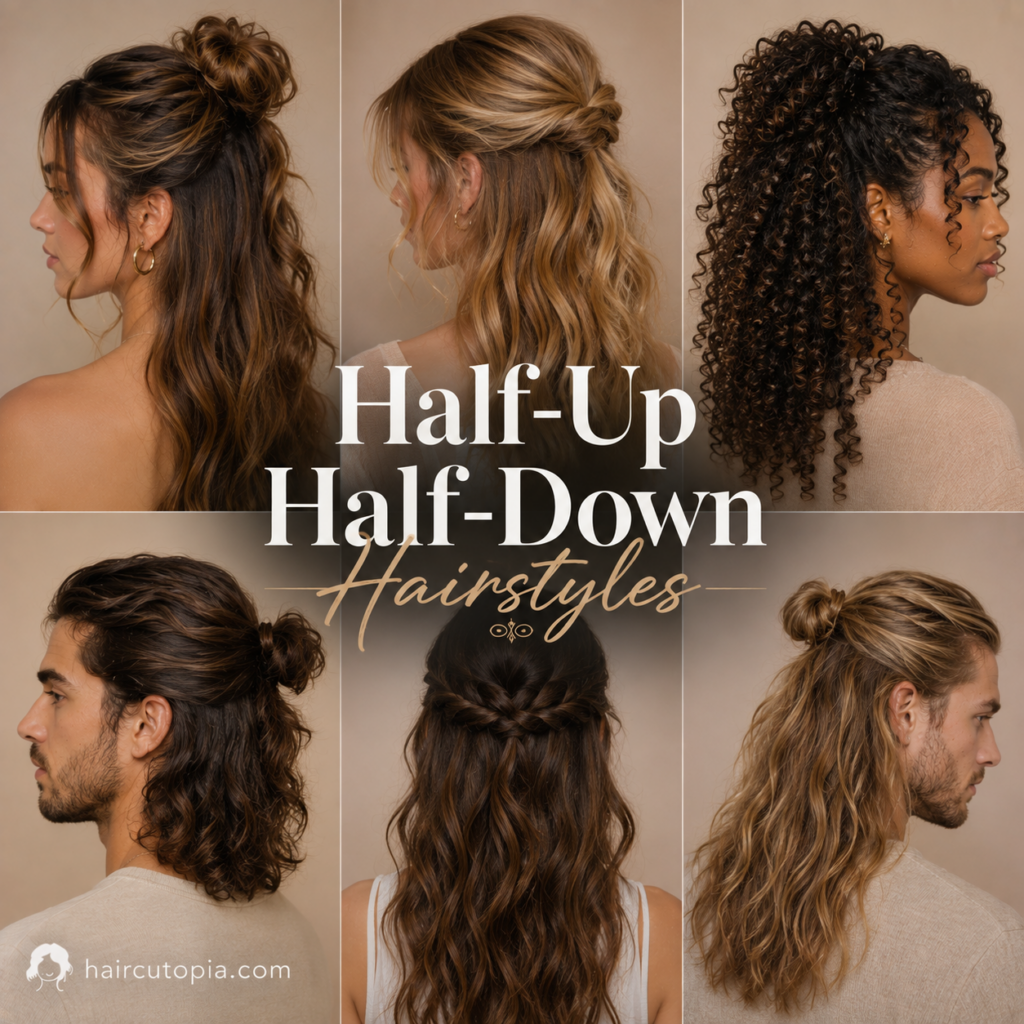
Half-up ponytails are one of the simplest half-up half-down hairstyles when you want to keep hair away from the face without gathering everything into a full ponytail.
The style works with:
- Straight hair
- Waves
- Curls
- Coils
- Braids
You can position the ponytail high for additional lift or lower for a softer appearance.
A small section creates a subtle half-up effect, while gathering more hair makes the ponytail more prominent.
Ponytail Hairstyles With Braids
You don’t need to braid the entire ponytail to incorporate braided detail.
Try:
- One small braid wrapped around the elastic
- Two front braids leading backward
- A side braid joining the ponytail
- Several small accent braids through the length
- A braided base with a loose ponytail
- A braided section underneath the ponytail
Small braided details can make a basic ponytail look much more intricate.
Ponytail Hairstyles With Bangs
Bangs can stay visible with almost any ponytail.
Curtain Bangs
Curtain bangs pair naturally with high, low, and messy ponytails.
They provide framing while the rest of the hair stays pulled back.
Full Bangs
Full bangs create a strong contrast with a sleek ponytail.
Curly Bangs
Curly bangs can remain part of a high curly ponytail or puff.
Side-Swept Bangs
Side-swept bangs work particularly well with lower or off-center ponytails.
Ponytails With Face-Framing Pieces
Leaving a few sections around the face can soften a ponytail.
The pieces can be:
- Straight
- Curled
- Wavy
- Naturally textured
Start with less hair than you think you need.
You can always pull out another section, but putting too much hair back into an already finished ponytail can be frustrating.
Wrapped Ponytail Hairstyles
Wrapping hair around the elastic is one of the simplest ways to make a ponytail look more finished.
After securing the ponytail:
- Take a small section from underneath.
- Wrap it around the elastic.
- Secure the end underneath with a pin.
This works with high, medium, and low ponytails.
The wrapped section can also be braided before it’s placed around the base.
Ponytail Hairstyles With Accessories
Accessories can change a ponytail without adding much styling time.
Try:
- Bows
- Scrunchies
- Barrettes
- Ribbons
- Scarves
- Decorative elastics
- Hair cuffs
- Clips
- Pearls or decorative pins
Choose accessories based on the occasion.
A large bow can make the hairstyle playful, while a metallic cuff can create a cleaner, more minimalist look.
Easy Ponytail Hairstyles
One reason ponytails remain so popular is that they can be created quickly, making them a staple among easy hairstyles for busy mornings, workdays, school, and casual styling.
Easy variations include:
- Classic high ponytail
- Low ponytail
- Half-up ponytail
- Wrapped ponytail
- Side ponytail
- Braided ponytail
- Bubble ponytail
- Curly ponytail
- Low ponytail with a center part
- Messy ponytail with face-framing pieces
Once you know the basic technique, most variations only add one or two extra steps.
Ponytail Hairstyles for Work
A ponytail can be practical for work because it keeps hair away from the face without requiring a full updo.
Depending on your workplace, consider:
- Low ponytails
- Sleek ponytails
- Wrapped ponytails
- Braided ponytails
- Natural curly ponytails
- Men’s low ponytails
The hairstyle doesn’t necessarily need to be completely smooth to look put together.
Ponytail Hairstyles for School
For school, a good ponytail should be comfortable enough to wear for several hours.
Options include:
- High ponytails
- Low ponytails
- Braided ponytails
- Bubble ponytails
- Half-up ponytails
- Curly ponytails
If you’re participating in sports or other physical activities, make sure the style is secure without pulling excessively around the hairline.
Formal Ponytail Hairstyles
Ponytails can absolutely work as formal hairstyles, especially when the placement, roots, texture, and finishing details are styled with a more polished approach.
The difference usually comes down to the finish and details.
Formal High Ponytail
A high ponytail with polished roots and styled lengths creates a dramatic silhouette.
Formal Low Ponytail
A smooth low ponytail can look minimalist and sophisticated.
Wavy Formal Ponytail
Adding waves gives the ponytail movement and volume.
Curly Formal Ponytail
Natural or styled curls can create a fuller formal look.
Braided Formal Ponytail
Braids can be incorporated at the base, through the length, or as small accents.
Ponytail Hairstyles for Weddings
Ponytails can be incorporated into wedding hairstyles for couples, wedding-party members, and guests, with options ranging from sleek low ponytails to curly, braided, and textured styles.
Wedding ponytail ideas include:
- Low wavy ponytails
- High curly ponytails
- Sleek ponytails
- Braided ponytails
- Textured ponytails
- Wrapped ponytails
Decorative pins, flowers, pearls, combs, or other accessories can be positioned around the base.
If you’re wearing a veil or headpiece, make sure its placement works with the ponytail before the event.
Ponytail Hairstyles for Prom
Ponytails can be glamorous prom hairstyles without requiring an elaborate updo, with high, sleek, curly, braided, bubble, and voluminous variations all fitting the occasion.
Popular options include:
- High curly ponytails
- Sleek high ponytails
- Bubble ponytails
- Braided ponytails
- Low wavy ponytails
- Voluminous ponytails
A ponytail is also practical if you expect to spend much of the evening dancing.
Ponytail Hairstyles for Exercise and Active Days
Ponytails are useful for exercise because they keep longer hair contained.
However, repeatedly wearing an extremely tight ponytail in exactly the same position can put stress on the same areas.
Consider changing the placement occasionally.
Braided ponytails can also help control the length during more active movement.
How to Make a Ponytail Look Fuller
If you want a fuller-looking ponytail, focus on shape rather than simply making it tighter.
You can try:
- Adding texture through the lengths
- Loosening the crown slightly
- Separating curls after the style is secure
- Positioning the ponytail higher
- Gently expanding a braid
- Using layers and natural texture to create movement
Avoid pulling excessively at the base in an attempt to create more volume.
How to Smooth a Ponytail
For a smoother finish:
- Detangle the hair using a method appropriate for your texture.
- Decide where you want the ponytail positioned.
- Direct the hair toward that point.
- Secure the ponytail.
- Smooth only the sections that need adjustment.
- Apply an appropriate finishing product if desired.
Trying to repeatedly brush an already secured ponytail can create unnecessary tension.
It’s usually easier to establish the shape before tightening the elastic.
How to Hide a Ponytail Elastic
Wrapping hair around the base is the classic method.
You can also use:
- A decorative cuff
- A ribbon
- A bow
- A scrunchie
- A scarf
Whether you hide the elastic at all is entirely a style choice.
A visible accessory can become part of the look.
How to Keep a Ponytail From Slipping
Ponytails may slide when the hair is extremely smooth or when the elastic doesn’t provide enough grip.
Try:
- Using an elastic appropriate for your hair density
- Adding a small amount of texture before styling
- Avoiding heavy products near the roots
- Securing the base firmly without overtightening
- Using pins strategically if needed
If your ponytail consistently slips, the problem may be the elastic rather than your technique.
How Tight Should a Ponytail Be?
A ponytail should feel secure without hurting.
Persistent scalp pain, headaches, or strong pulling around the hairline are signs that the style is too tight.
This matters particularly with high ponytails, which can place more tension on the front and sides of the hairline.
If the hairstyle hurts, loosen or reposition it.
How to Reduce Ponytail Tension
If you wear ponytails frequently, small changes can reduce repeated stress.
Consider:
- Alternating between high and low placements
- Using gentler elastics
- Avoiding excessive tightness
- Wearing the hair down sometimes
- Choosing buns, braids, or clips on other days
- Avoiding repeatedly securing the exact same sections
A ponytail doesn’t need to feel tight to look intentional.
How to Choose the Right Ponytail
The best ponytail depends on your hair and what you’re doing that day.
Consider Your Hair Length
Longer hair provides more options for braids, bubbles, and dramatic ponytails, while shorter hair may work better with low or half-up styles.
Consider Your Texture
Straight hair creates clean lines. Waves provide movement. Curls and coils naturally add volume.
Use those characteristics rather than assuming every ponytail needs the same finish.
Consider the Occasion
A messy ponytail may be ideal for errands, while a sleek or wavy ponytail can work better for a formal event.
Consider Comfort
If you’re wearing the hairstyle all day, comfort matters more than achieving the highest possible placement.
Common Ponytail Hairstyle Mistakes
Ponytails are simple, but a few habits can make them uncomfortable or harder on the hair.
Try to avoid:
- Pulling the ponytail unnecessarily tight
- Repeatedly wearing it in exactly the same position
- Using elastics that snag or pull the hair
- Ignoring scalp discomfort
- Applying excessive product
- Fighting your natural texture when it could be part of the style
- Tightening the elastic repeatedly throughout the day
- Making a high ponytail so heavy that it causes pulling
- Expecting every loose section to remain perfectly smooth
A little movement doesn’t mean the hairstyle has failed.
Frequently Asked Questions About Ponytail Hairstyles
What are the most popular ponytail hairstyles?
High ponytails, low ponytails, sleek ponytails, curly ponytails, braided ponytails, bubble ponytails, and half-up ponytails are among the most versatile options.
How can I make a basic ponytail look better?
Try changing the placement, wrapping hair around the elastic, adding waves or curls, incorporating a braid, defining your part, or adding an accessory.
Can short hair go into a ponytail?
It depends on the length. Many bobs and lobs can be gathered into low or half-up ponytails, although shorter layers may need pins or may remain loose.
Are ponytails appropriate for formal events?
Yes. Sleek, curly, wavy, braided, high, and low ponytails can all work for formal events when styled with an intentional finish.
How do I make my ponytail look fuller?
Texture, curls, waves, strategic placement, and gently adjusting the shape after securing the hair can make a ponytail appear fuller.
Can curly hair be worn in a ponytail?
Absolutely. Curly hair works especially well in high, low, side, half-up, and formal ponytails because the natural texture provides volume.
Are tight ponytails bad for hair?
Frequently wearing hairstyles with excessive tension may put unnecessary stress on the hair and hairline. A ponytail should feel secure without causing pain or persistent pulling.
How do I keep my ponytail up all day?
Use an elastic appropriate for your hair density, create a secure foundation, and add texture or strategic pins if needed. If the ponytail is heavy, changing the placement may also help.
Can men wear ponytail hairstyles?
Yes. Men with enough length can wear low, mid-height, curly, braided, or half-up ponytails depending on their hair and preferred style.
Finding the Right Ponytail Hairstyle for You
The ponytail has lasted as a go-to hairstyle for a reason.
It’s simple enough to create in minutes but flexible enough to look completely different depending on how you wear it.
You can keep things practical with a basic low ponytail, emphasize natural curls with a high textured style, add detail with braids or bubbles, or turn the same familiar hairstyle into something polished enough for a wedding or prom.
Start with your hair’s natural length and texture. Then experiment with placement, volume, parts, accessories, and the finish of the ponytail itself.
You don’t need to reinvent the hairstyle.
Sometimes moving it a few inches higher, leaving a couple of curls loose, or wrapping one small section around the elastic is all it takes to make a ponytail feel completely different.