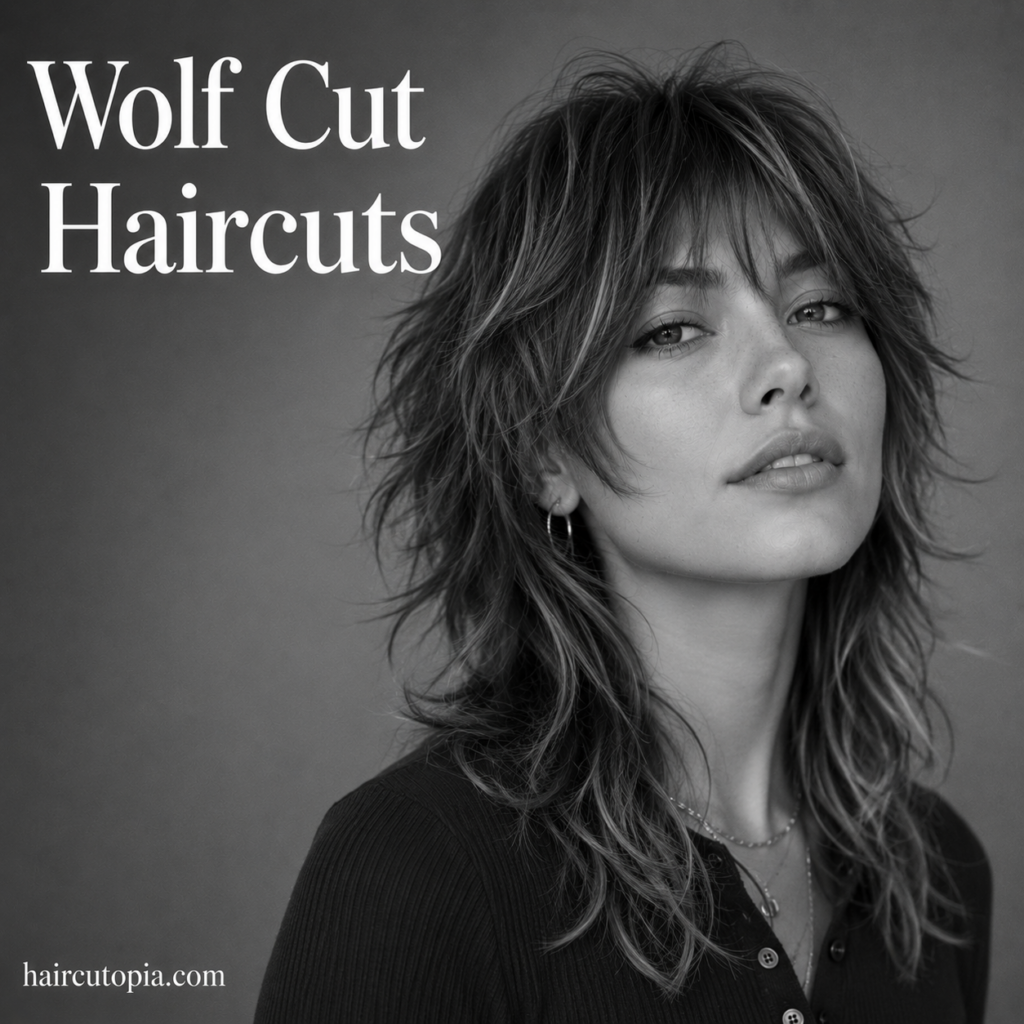
The wolf cut isn’t meant to sit perfectly in place.
That’s part of its appeal.
With shorter layers around the crown, plenty of movement through the middle, and lighter lengths toward the ends, the wolf cut creates a deliberately textured shape. Some versions are dramatic, with obvious separation between the top and bottom. Others soften the formula with longer layers, subtle face framing, and a more blended finish.
Either way, movement is the point.
The haircut borrows ideas from both the shag and mullet, but modern wolf cuts can be much more wearable than that description might suggest. They can be short or long, straight or curly, polished or messy. Bangs are common, though they’re not required.
What matters most is how the layers are distributed.
A good wolf cut should create volume and texture without making the lower sections look unnecessarily thin. The shortest layers need to work with your natural texture, density, and styling habits rather than simply copying a reference photo.
If you’re considering a wolf cut, here’s how the style works, the different variations to consider, and what you should know before committing to all those layers.
What Is a Wolf Cut?
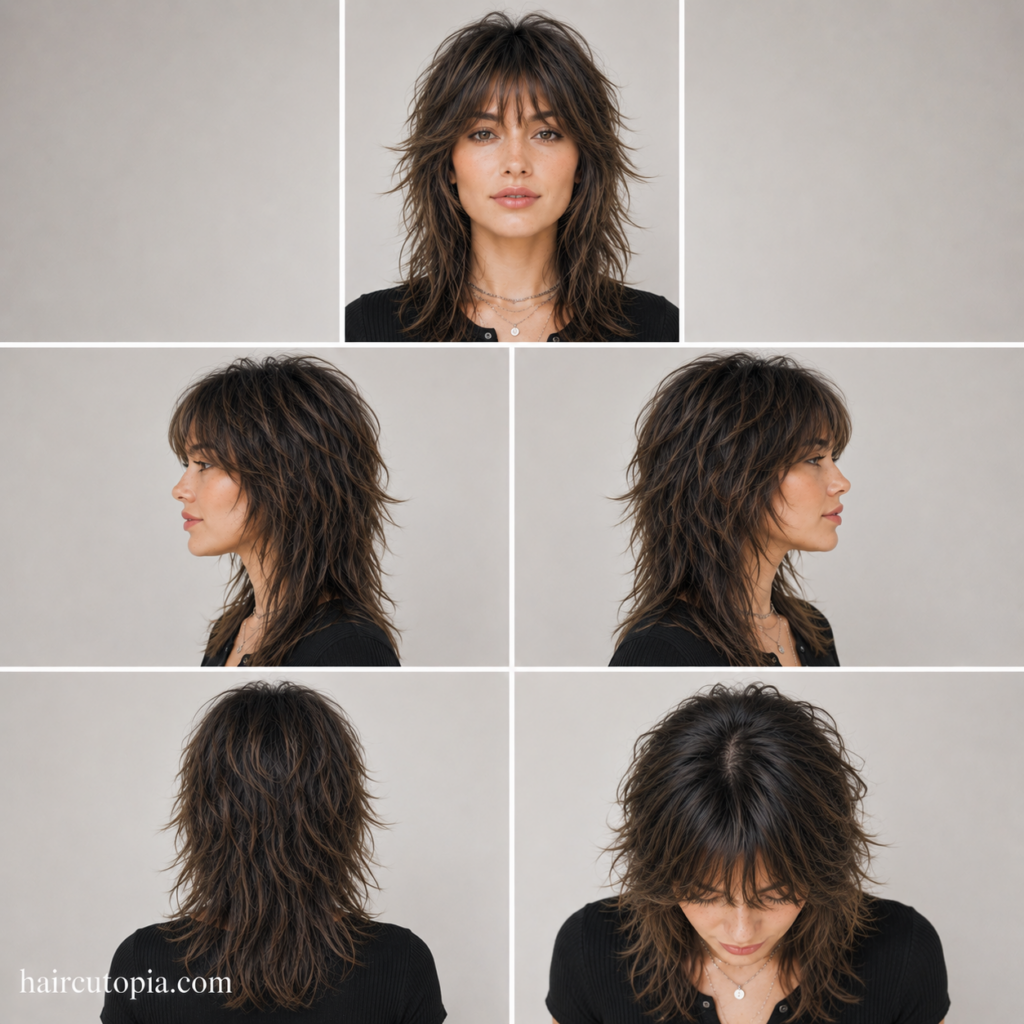
A wolf cut is one of the more dramatic types of layered haircuts, typically combining shorter, fuller layers around the crown with longer, lighter sections through the bottom.
The haircut creates a noticeable difference between the upper and lower portions of the hair.
Common characteristics include:
- Shorter crown layers
- Longer lower sections
- Face-framing pieces
- Textured or feathered ends
- Volume around the top
- Reduced weight through the lengths
- Optional bangs
- A tousled, lived-in finish
The exact proportions can vary dramatically.
Some wolf cuts have very short crown layers and thin, separated ends. Others use longer, softer layers that create a less extreme silhouette.
That flexibility has helped the haircut move beyond one specific trend and become a broader category of layered style.
Why Is It Called a Wolf Cut?
The name reflects the haircut’s intentionally wild, textured appearance.
Rather than creating a perfectly controlled silhouette, the layers are designed to produce movement and separation.
The result can look slightly untamed—hence the “wolf” description.
Of course, the haircut doesn’t have to be messy.
Modern versions can be styled smoothly or softly while still maintaining the distinctive layered structure.
What Makes a Wolf Cut Different?
Many layered haircuts add movement, so what specifically makes a wolf cut a wolf cut?
It’s largely about contrast.
Traditional long layers tend to flow gradually from shorter sections into longer ones, while wolf cuts make the difference between those lengths more noticeable.
The crown is generally:
- Shorter
- Fuller
- More layered
- More voluminous
The lower lengths tend to be:
- Longer
- Lighter
- More separated
- More textured
That contrast creates the signature silhouette.
How dramatic it becomes depends on your preference.
Wolf Cut vs. Shag Haircut
Wolf cuts and shags have a lot in common.
Wolf cuts and shag haircuts have a lot in common, particularly their emphasis on layering, texture, crown movement, and fringe.
The biggest difference is usually the degree of contrast.
A shag can have very blended layers and maintain more fullness throughout the lengths.
A wolf cut generally emphasizes a stronger transition between the shorter, fuller crown and longer lower sections.
Think of the wolf cut as a more exaggerated relative of the shag.
However, the categories overlap considerably.
A heavily layered shag may resemble a wolf cut, while a soft wolf cut may look very similar to a modern shag.
Instead of focusing too much on terminology, show your stylist exactly how much crown volume and length contrast you want.
Wolf Cut vs. Mullet
The wolf cut also shares characteristics with the mullet.
Both can feature shorter hair around the top and front with additional length through the back.
But a wolf cut generally uses more blended layering throughout the entire head.
A mullet tends to create a clearer distinction between shorter front or side sections and the longer back.
Wolf cuts usually feel:
- More layered
- Fuller around the crown
- Softer through the transitions
- More connected around the sides
That said, some dramatic wolf cuts intentionally lean toward a mullet-inspired shape.
There’s no hard boundary between the two.
Why Wolf Cut Haircuts Are So Popular
Among heavily layered women’s haircuts, the wolf cut can create a major change without necessarily requiring you to sacrifice overall length.
That’s a big part of its appeal.
Someone with long hair can keep much of that length while introducing dramatically shorter layers through the crown and around the face.
The haircut can also encourage natural texture.
Removing weight allows waves and curls to spring up more easily, creating additional movement.
Wolf cuts are especially appealing if you like hair that feels:
- Layered
- Voluminous
- Textured
- Tousled
- Face-framing
- Slightly edgy
- Less structured
There’s also plenty of room for personalization.
A subtle wolf cut can be soft and wearable. A dramatic version can make the haircut itself the centerpiece of your look.
Popular Types of Wolf Cut Haircuts
The basic formula can be adjusted in many ways.
Classic Wolf Cut
A classic wolf cut features noticeable crown layers that transition into longer, lighter lengths.
The upper section has visible volume, while the bottom maintains length and movement.
Bangs or fringe often complete the shape.
This is the version most closely associated with the recognizable wolf-cut silhouette.
Soft Wolf Cut
A soft wolf cut reduces the contrast.
The crown layers remain shorter, but they blend more gradually into the lower lengths.
The ends also retain more fullness.
This can be a good choice if you like the movement of a wolf cut but don’t want an extremely choppy finish.
It’s also easier to transition back into traditional layers later.
Layered Wolf Cut
All wolf cuts are layered, but some versions emphasize the layering throughout the entire haircut.
Rather than concentrating most of the shorter pieces at the crown, layers continue through the mid-lengths.
This creates movement from top to bottom.
Choppy Wolf Cut
A choppy wolf cut makes the separation between layers more visible.
Individual pieces are easier to distinguish, especially around the crown and face.
Textured ends add to the effect.
This version works well if you want an intentionally undone finish rather than smooth, blended layers.
Shaggy Wolf Cut
A shaggy wolf cut brings the style closer to a traditional shag.
The layers remain prominent, but the silhouette may feel softer and less disconnected.
Natural waves work particularly well with this approach.
Wolf Cut With Bangs
Bangs can make the wolf-cut shape feel more complete by connecting the shorter crown layers to the front.
Popular options include:
- Curtain bangs
- Wispy bangs
- Choppy bangs
- Bottleneck bangs
- Short textured fringe
- Side-swept bangs
The right choice depends on your hairline, texture, and how much daily styling you want.
Wolf Cut Without Bangs
Bangs aren’t required.
Longer face-framing layers can create movement around the front while leaving the forehead open.
This also provides more flexibility if you like changing your part.
Short Wolf Cut Haircuts
A short wolf cut creates the layered shape within a compact length.
The haircut may fall around the jaw, neck, or shoulders depending on the version.
Short crown layers can create significant volume.
The lower sections remain longer and lighter, preserving the signature contrast.
Short wolf cuts can work particularly well with:
- Choppy texture
- Natural waves
- Short fringe
- Crown volume
- Piecey styling
Because the overall haircut is short, the differences between the layers can become especially noticeable.
Medium Wolf Cut Haircuts
Medium-length wolf cuts provide enough room to create strong layering while remaining relatively easy to manage.
Shoulder and collarbone lengths are particularly versatile.
There’s enough hair for:
- Crown volume
- Face framing
- Curtain bangs
- Tousled waves
- Longer lower layers
Depending on the shortest pieces, you may also retain enough length for ponytails and other simple updos.
Long Wolf Cut Haircuts
A long wolf cut keeps substantial overall length while dramatically changing the upper portion of the hairstyle.
The longest pieces may remain well below the shoulders while shorter crown and face-framing layers create movement above.
This creates one of the strongest wolf-cut contrasts.
Long wolf cuts can be especially useful when very long hair feels heavy or lacks movement.
The main consideration is density.
If too much hair is removed from the lower sections, the ends can begin looking thin.
How Much Layering Should a Wolf Cut Have?
There isn’t one correct amount.
The intensity of the layering determines how dramatic the haircut becomes.
Soft Wolf Cut Layers
Soft layers provide a subtle introduction to the style.
The crown is shorter, but the transition into the lower sections remains blended.
This is a good option if you’re unsure about dramatic layering.
Moderate Wolf Cut Layers
Moderate layering creates a recognizable wolf-cut silhouette without making the difference between sections extreme.
There’s visible crown volume and plenty of movement through the lengths.
Dramatic Wolf Cut Layers
Dramatic wolf cuts use a much stronger difference between the shortest and longest pieces.
The crown can become very full while the lower sections appear lighter and more separated.
This creates the boldest version of the style.
It also requires enough hair density to support the amount of layering.
Wolf Cuts for Fine Hair
Fine hair can wear a wolf cut, but aggressive layering needs to be approached carefully.
The challenge is density.
Removing too much hair can make the lower lengths look thin or stringy.
A fine-hair wolf cut often works better with:
- Softer crown layers
- Less thinning
- A fuller perimeter
- Moderate face framing
- Wispy fringe
- Short or medium overall length
Shorter layers can create lift around the crown, which may make the upper portion appear fuller.
The lower sections need enough density to balance that volume.
Lightweight styling products are usually preferable.
Heavy creams and waxes can quickly flatten fine hair.
Wolf Cuts for Thick Hair
Thick hair gives a wolf cut plenty of material for dramatic layering.
Removing internal weight can make dense hair feel lighter and easier to move.
Thick hair can often support:
- Short crown layers
- Heavy face framing
- Choppy texture
- Long wolf cuts
- Dramatic length differences
Still, more thinning isn’t automatically better.
Removing too much internal weight can cause shorter sections to expand or become difficult to control.
Strategic layering matters more than simply reducing density.
Wolf Cuts for Straight Hair
Straight hair displays the wolf cut’s structure clearly.
The difference between shorter crown layers and longer lower pieces becomes particularly visible.
This can create a strong, graphic shape.
Straight wolf cuts can be styled:
- Smooth
- Piecey
- Tousled
- Voluminous
- Flipped at the ends
If your hair naturally lies flat, root volume through the crown can help emphasize the haircut.
A small amount of texture spray or lightweight styling product can add separation through the ends.
Wolf Cuts for Wavy Hair
Wavy hair is naturally suited to wolf cuts.
Removing weight can allow the wave pattern to become stronger and more visible.
The layers help distribute movement throughout the haircut rather than leaving all the texture near the ends.
Some wavy wolf cuts can be largely air-dried.
A lightweight product may be enough to encourage the natural pattern.
Keep in mind that your hair may appear shorter once excess weight is removed and the waves spring upward.
Wolf Cuts for Curly Hair
Curly wolf cuts can create substantial volume.
Shorter crown layers allow curls to form higher on the head, while longer lower sections preserve length.
The key is understanding shrinkage.
A curl that appears long while wet or stretched can sit significantly higher once dry.
Layers should be planned around the finished curl pattern.
Curly wolf cuts can range from soft and rounded to highly dramatic depending on how short the crown is cut.
Wolf Cuts for Coily Hair
Coily textures can create a bold wolf-cut silhouette with plenty of natural volume.
The upper layers can build fullness through the crown while longer sections create additional shape below.
Depending on the desired finish, the haircut can be:
- Rounded
- Elongated
- Highly layered
- Softly shaped
- Dramatically tapered through the ends
Shrinkage and density are especially important when deciding where the shortest layers should fall.
Wolf Cuts for Different Face Shapes
The wolf cut offers plenty of opportunities for customization around the face.
The placement of bangs, crown volume, and face-framing layers can all be adjusted to change how the wolf cut sits around the face.
Wolf Cuts for Oval Faces
Oval faces can experiment with most wolf-cut variations.
Short fringe, curtain bangs, dramatic crown layers, and long face framing can all work.
Hair density and natural texture may be more useful guides than face shape.
Wolf Cuts for Round Faces
Longer face-framing layers can create vertical movement.
Additional crown volume can also emphasize height.
Curtain bangs can introduce diagonal lines around the face.
You can also choose a fuller silhouette if you prefer emphasizing softness rather than trying to visually lengthen the face.
Wolf Cuts for Square Faces
Wispy or curved face-framing layers can create movement around a defined jawline.
Curtain bangs can add softness around the forehead.
Alternatively, a choppier wolf cut can complement strong facial angles rather than trying to soften them.
Wolf Cuts for Heart-Shaped Faces
Face-framing pieces can add movement around the cheekbones and jaw.
Curtain and bottleneck bangs also work naturally because they transition into the surrounding layers.
Wolf Cuts for Long Faces
Bangs can create additional horizontal emphasis across the forehead.
Volume through the sides can also alter the overall silhouette.
If you don’t want to emphasize length, avoid creating all of the haircut’s volume directly at the highest point of the crown.
Wolf Cut Haircuts With Curtain Bangs
Curtain bangs fit naturally into the wolf cut because they connect the shorter front pieces to the rest of the layers.
The fringe separates near the center and gradually becomes longer toward the sides.
That transition can continue directly into the face framing.
Curtain bangs can be:
- Short and voluminous
- Long and sweeping
- Wispy
- Choppy
- Softly blended
Longer versions provide more styling flexibility and are generally easier to grow out.
Wolf Cut Haircuts With Wispy Bangs
Wispy bangs provide light forehead coverage without creating a heavy fringe line.
They work particularly well with softer wolf cuts and fine hair.
The natural separation between the pieces complements the textured haircut.
Wolf Cut Haircuts With Choppy Bangs
Choppy bangs emphasize the edgier side of the wolf cut.
The fringe has visible separation and doesn’t need to fall perfectly evenly.
This style works especially well when the rest of the haircut has strong, piecey layers.
Wolf Cut Haircuts With Bottleneck Bangs
Bottleneck bangs are shorter near the center and become longer toward the sides.
That shape makes them easy to blend into wolf-cut face framing.
They provide more forehead coverage than traditional curtain bangs while still opening around the face.
Wolf Cuts With a Middle Part
A middle part can create balance between the two sides of the haircut.
It works particularly well with curtain bangs and symmetrical face-framing layers.
The part doesn’t need to be perfectly centered.
Following your natural part can reduce daily styling.
Wolf Cuts With a Side Part
A side part changes the volume distribution.
One side of the crown may appear fuller, while longer front layers sweep across the forehead.
This can create a more asymmetrical, tousled appearance.
A side part is also useful if your hair naturally grows strongly in one direction.
Soft vs. Dramatic Wolf Cuts
Not every wolf cut needs extreme layering.
A soft wolf cut emphasizes:
- Blended layers
- Fuller ends
- Longer crown pieces
- Subtle face framing
- Easier grow-out
A dramatic wolf cut emphasizes:
- Short crown layers
- Strong volume
- Choppy texture
- Lighter lower lengths
- Obvious separation
If you’re trying the style for the first time, a softer version may be easier to adjust to.
You can always make the layers shorter later.
If you prefer substantial volume and face framing while keeping the layers longer, a butterfly cut offers a softer alternative with more flowing transitions between the shorter and longer sections.
How to Style a Wolf Cut
Wolf cuts are often associated with effortless texture, but “effortless” still depends on your natural hair.
Air-Dried Wolf Cut
If your hair has natural wave or curl, apply products suited to your texture and allow it to dry.
The layers should help create movement on their own.
Tousled Wolf Cut
Use a small amount of lightweight texture product and work it through the layers.
Focus on separation rather than making every section identical.
Voluminous Crown
Lift the roots through the upper portion while drying.
Shorter layers naturally support more volume.
Wavy Wolf Cut
Loose waves emphasize the different layer lengths.
For a relaxed finish, vary the direction and size of the waves rather than making them completely uniform.
Straight Wolf Cut
Straightening the hair makes the layering especially visible.
A small amount of styling product through the ends can create piecey definition.
Curly Wolf Cut
Allow curls to follow the layered shape.
Products that provide moisture and definition can help keep the curl pattern visible without removing natural volume.
What Styling Products Work for a Wolf Cut?
The right products depend more on your hair texture than the haircut itself.
Useful options may include:
- Lightweight mousse
- Volumizing spray
- Texture spray
- Curl cream
- Wave-enhancing products
- Flexible-hold hairspray
- Lightweight styling paste
- Anti-frizz products
You don’t need all of them.
Fine straight hair may only need a lightweight volumizer.
Thick curly hair may benefit more from moisture and definition.
The goal is to support the texture without making the layers stiff.
Are Wolf Cut Haircuts Low Maintenance?
A wolf cut can be surprisingly easy to maintain when it works with your natural texture.
The haircut doesn’t depend on every strand sitting perfectly.
A little variation can make the style look better.
However, a wolf cut isn’t automatically wash-and-go.
If your reference style has strong waves but your natural hair is completely straight, you’ll probably need styling to recreate that appearance.
Bangs may also require regular attention.
The easiest wolf cut is one designed around the texture you already have.
How Often Should You Trim a Wolf Cut?
Many wolf cuts can go approximately 8–12 weeks between full trims.
The heavily layered shape tends to become softer rather than immediately looking overgrown.
Bangs may need maintenance sooner.
Your schedule depends on:
- Overall length
- Crown layer length
- Bangs
- Hair growth rate
- Desired amount of texture
- Whether you’re maintaining or growing the cut
A dramatic wolf cut may need reshaping sooner if preserving strong crown volume is important.
A soft, long version can often grow for longer.
How to Ask Your Hairstylist for a Wolf Cut
Don’t rely on the name alone.
One stylist’s interpretation of a wolf cut may be much more dramatic than another’s.
Bring reference photos and discuss the individual features.
Talk about:
- Your desired overall length.
- How short you want the crown layers.
- How dramatic you want the difference between the top and bottom.
- Where you want face-framing layers to begin.
- How much density you want to preserve through the ends.
- Whether you want bangs.
- How much daily styling you’re willing to do.
- Whether you normally wear your natural texture.
If you have fine hair, discuss how much layering your density can support.
If you have curls, discuss the finished dry length rather than only the stretched length.
And if you’re nervous, start with longer crown layers.
You can always go shorter.
Going From Long Hair to a Wolf Cut
A wolf cut can transform long hair without removing all of the length.
That’s one reason it’s such an appealing option.
You may be able to keep the longest sections almost untouched while cutting dramatically shorter layers above them.
Even though the length remains, expect the haircut to feel very different.
You may notice:
- More crown volume
- Stronger natural waves
- Lighter ends
- More movement
- Increased face framing
- Less overall weight
If ponytails and buns are important to you, discuss the shortest layers before cutting.
Very short front or crown pieces may fall out of certain styles.
Growing Out a Wolf Cut
Growing out a wolf cut means gradually reducing the difference between the shortest and longest layers.
The process is usually manageable because the haircut simply becomes softer over time.
As the crown layers grow, they gain weight and create less volume.
Meanwhile, strategic trims can preserve the overall length while slowly bringing the lower sections closer to the upper layers.
If your goal is eventually a more traditional layered haircut, avoid repeatedly cutting the crown back to its original wolf-cut length.
Each appointment should gradually move the shape toward your target.
Who Should Consider a Wolf Cut?
A wolf cut may be a good choice if you:
- Want lots of movement
- Like heavily layered hair
- Want more crown volume
- Prefer textured or tousled styles
- Want to keep overall length while making a noticeable change
- Have natural waves or curls you want to encourage
- Like face-framing layers
- Want bangs or textured fringe
- Feel your current hair is too heavy
- Prefer a haircut that doesn’t need to look perfectly polished
The amount of layering can be adjusted considerably, so you don’t need to choose the most dramatic version.
Common Wolf Cut Mistakes to Avoid
Wolf cuts rely heavily on layer placement, which means small decisions can have a big effect.
Cutting the Crown Too Short
Short crown layers create dramatic volume.
If you’re not sure you want that much contrast, begin longer.
Removing Too Much Density From Fine Hair
Fine hair can lose fullness quickly when heavily layered.
Preserving enough hair through the lower sections is important.
Over-Thinning Thick Hair
Thick hair may need weight removal, but aggressive thinning isn’t always the answer.
Shorter pieces can become even more voluminous when too much support is removed.
Ignoring Shrinkage
Waves, curls, and coils may spring significantly higher once the weight is gone.
Always consider the dry result.
Choosing a Heavily Styled Reference Photo
Look carefully at whether the haircut you like is naturally textured or has been curled, waved, and styled.
The haircut alone may not recreate the entire appearance.
Forgetting About Grow-Out
Very short crown layers take time to catch up with the rest of the hair.
If you’re uncertain, choose a softer wolf cut first.
Frequently Asked Questions About Wolf Cut Haircuts
What is a wolf cut haircut?
A wolf cut is a heavily layered hairstyle featuring shorter, fuller layers around the crown and longer, lighter sections through the bottom.
What is the difference between a wolf cut and a shag?
Both are heavily layered. Wolf cuts generally emphasize a stronger contrast between crown volume and the longer lower sections, while shags can have a more blended silhouette.
Is a wolf cut the same as a mullet?
No.
The styles share some characteristics, but wolf cuts generally use more connected layering through the sides and crown. Mullets typically create a stronger distinction between the shorter front and longer back.
Are wolf cuts good for fine hair?
They can be, but the layering should be less aggressive.
Preserving density through the lower lengths helps prevent fine hair from appearing thin.
Are wolf cuts good for thick hair?
Yes.
Layering can remove weight and create movement throughout thick hair, although excessive thinning should be avoided.
Do wolf cuts work on straight hair?
Yes.
Straight hair clearly displays the layered structure and can be styled smooth, piecey, tousled, or with added waves.
Are wolf cuts good for wavy hair?
Yes.
Removing weight can encourage natural waves and create more movement throughout the haircut.
Can curly hair have a wolf cut?
Absolutely.
Layering can create crown volume and distribute curls throughout the shape. Shrinkage should be considered carefully.
Does a wolf cut need bangs?
No.
Bangs are common, but longer face-framing layers can create the front shape without fringe.
What bangs work with a wolf cut?
Curtain, wispy, choppy, bottleneck, short textured, and side-swept bangs can all complement wolf cuts.
How often should a wolf cut be trimmed?
Many wolf cuts can go around 8–12 weeks between full trims, although bangs may need maintenance sooner.
Is a wolf cut difficult to grow out?
Not necessarily.
The layers gradually soften as they grow. Strategic trims can slowly reduce the difference between the shortest and longest sections.
Final Thoughts on Wolf Cut Haircuts
The wolf cut is built around contrast.
Shorter layers create volume through the crown. Longer sections preserve length. Face framing connects everything around the front, while textured ends keep the haircut feeling light and full of movement.
How far you take that contrast is up to you.
A soft wolf cut can introduce movement without looking dramatically different from a modern layered style. A choppy version can make the short crown and long ends impossible to miss.
Neither approach is inherently better.
The right version depends on your hair density, natural texture, desired length, and how much styling you’re willing to do.
Pay particular attention to the shortest layers. They have the biggest influence on the haircut’s shape—and they’ll take the longest to grow if you change your mind.
When those layers are chosen carefully, the wolf cut can deliver exactly what it’s known for: volume, movement, texture, and a slightly untamed finish that doesn’t need every strand to behave perfectly.

Related Posts
 Layered Haircuts: The Complete Guide to Layers for Every Hair Type and Length
 Butterfly Cut Haircuts: The Complete Guide to Voluminous, Layered Butterfly Styles
 Shag Haircuts: The Complete Guide to Layered, Textured Shag Styles
 Low Maintenance Layered Haircut Haircuts: 25 Easy Styles That Look Great with Minimal Effort