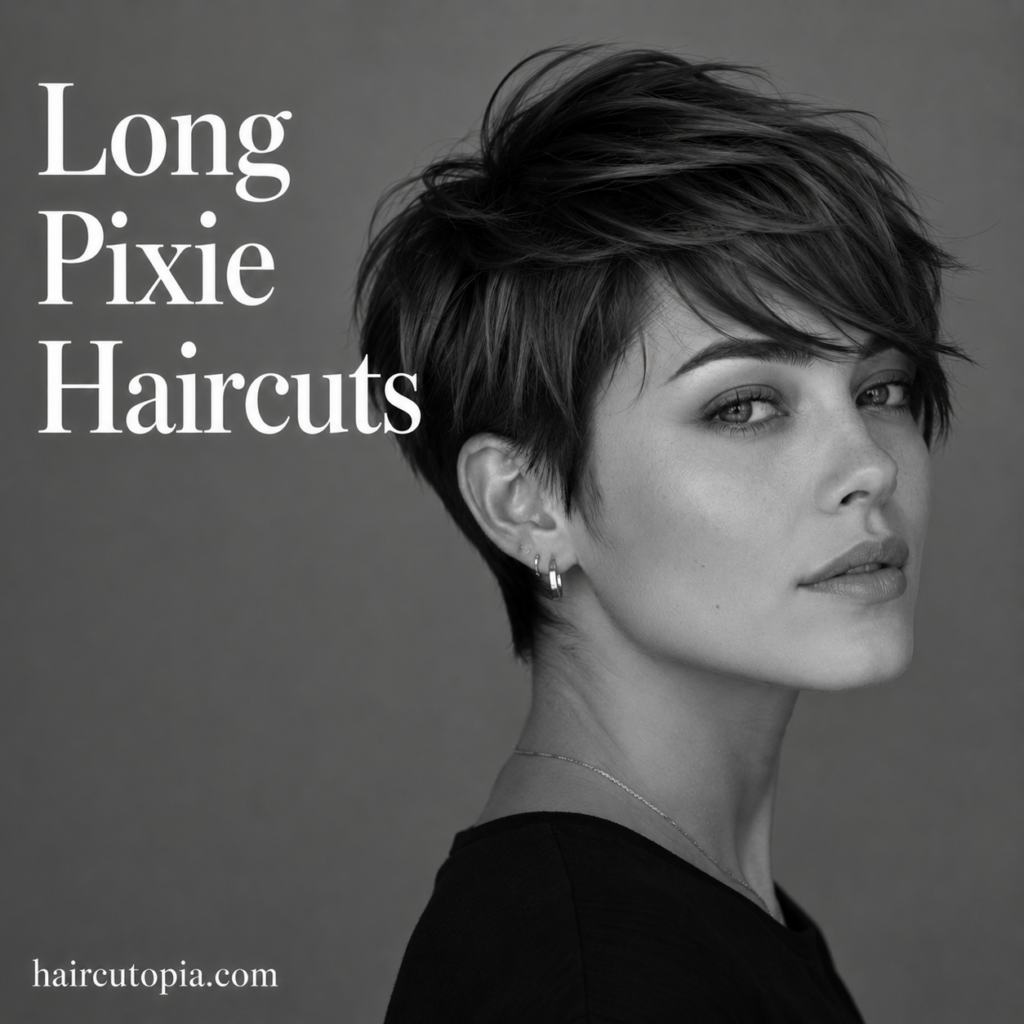
A long pixie is one of the easiest ways to get the impact of short hair without going extremely cropped.
It keeps the recognizable shape of a pixie but leaves extra length where it matters—through the top, crown, fringe, or sides. That little bit of additional hair opens up considerably more styling freedom. You can sweep the front across your forehead, add volume at the crown, create tousled texture, work with natural waves, or tuck longer pieces behind your ears.
The result can feel soft and feminine, edgy and textured, polished and sleek, or somewhere comfortably in between.
Long pixie haircuts are also useful if you’re transitioning between lengths. They can be a less dramatic first step into short hair or an intentional stage when growing out a traditional pixie.
The details make all the difference.
Where the length is preserved, how the sides are shaped, how much layering is added, and how the fringe connects to the rest of the haircut can completely change the finished look.
If you’re considering a longer pixie, here’s how to choose a version that works with your hair texture, face shape, and everyday routine.
What Is a Long Pixie Haircut?
A long pixie is a longer variation of the traditional pixie haircut, maintaining its basic cropped structure while leaving noticeably more length through selected areas.
The sides and back may still be relatively short, but the top, crown, bangs, or sections around the ears are kept longer.
Common features include:
- Longer hair through the top
- Side-swept or extended fringe
- Layered crown
- Tapered or softly cropped back
- Longer pieces around the ears
- Textured ends
- Optional undercut sections
- Enough length for multiple styling options
There’s no exact measurement that turns a regular pixie into a long pixie.
The difference is mostly about proportion.
If the haircut still feels distinctly short but has enough length to sweep, tousle, curl, or reshape, it generally falls into long-pixie territory.
Long Pixie vs. Classic Pixie: What’s the Difference?
A classic pixie tends to follow the head more closely.
The sides and back are short, and while the top may have some extra length, the overall silhouette remains compact.
A long pixie preserves more hair.
That might mean longer bangs, fuller sides, additional crown length, or all three.
The extra length gives you more styling possibilities, including:
- Deep side parts
- Sweeping bangs
- Tousled texture
- Defined waves
- Small curls
- Slicked-back styling
- Crown volume
- Ear tucks
A traditional pixie may take only a few minutes to style, but there are fewer ways to dramatically change its shape.
A longer pixie sits somewhere between that simplicity and the versatility of a bob.
Long Pixie vs. Bixie Haircut
Long pixies and bixie haircuts can look similar, especially when the pixie is approaching its longest proportions.
The distinction comes down mostly to the overall silhouette.
A long pixie still tends to maintain the cropped structure associated with a pixie. The neckline and sides may remain relatively short even when the top and fringe are longer.
A bixie blends characteristics of both a bob and pixie.
It generally keeps more length around the sides and back, creating a fuller perimeter and more movement around the head.
There’s plenty of overlap between the two.
Rather than worrying about the label, focus on where you want to preserve length.
If you want a cropped neckline with a long, sweeping top, you’re probably closer to a long pixie.
If you want more length around the ears, sides, and back as well, you may be moving toward a bixie.
Why Long Pixie Haircuts Are So Versatile
Among shorter women’s haircuts, one of the biggest advantages of a long pixie is its flexibility.
You get the lighter feel of short hair without losing all your styling options.
Leaving even a couple of extra inches through the front can dramatically change what you can do with the haircut.
One day you might wear it smooth and side-swept. The next, you can add texture and volume. Natural waves can be encouraged instead of straightened, and longer fringe can be tucked away when you want your face more exposed.
A long pixie can also be more forgiving as it grows.
Because the haircut already has softness and variation in length, a little growth doesn’t always change the silhouette as dramatically as it would with a very short precision pixie.
That can make it appealing if you like short hair but don’t want extremely frequent trims.
Popular Types of Long Pixie Haircuts
There are many ways to distribute the extra length.
Each approach creates a different personality.
Classic Long Pixie
A classic long pixie keeps the overall shape soft and balanced.
The sides and back remain shorter while the top and front have enough length for movement.
It isn’t heavily choppy or dramatically undercut.
Instead, the haircut relies on blended layers and a natural silhouette.
This can be a good option if you want something short but not overly edgy.
Layered Long Pixie
As with other layered haircuts, layers in a long pixie can control weight, create movement, and influence where volume develops.
They prevent the extra hair from becoming heavy and help create movement through the crown and top.
Longer layers produce a softer effect.
Shorter, more noticeable layers can create additional lift and texture.
The right balance depends on hair density.
Fine hair may need fewer layers to preserve fullness, while thick hair can often support more internal shaping.
Textured Long Pixie
A textured long pixie emphasizes movement and separation.
The ends don’t need to fall perfectly into place.
Instead, the haircut is designed to look good with a little variation.
Textured styles work particularly well if you prefer:
- Tousled finishes
- Piecey layers
- Natural waves
- Messier styling
- Visible movement
A small amount of styling product can help define individual sections without making the hair stiff.
Long Pixie With Side-Swept Bangs
Side-swept fringe is one of the most recognizable long-pixie features.
The front is left significantly longer than the sides, allowing it to sweep across the forehead.
The bangs may end around the eyebrow, cheekbone, or even lower depending on the desired look.
Longer fringe creates softness and provides multiple styling options.
You can sweep it across, tuck it behind the ear, add volume, or blend it into the rest of the top.
Long Pixie With Curtain Bangs
Curtain bangs aren’t limited to longer hair and can also be adapted to the shorter proportions of a long pixie.
On a long pixie, shorter curtain bangs can open around the center of the forehead and blend into longer side pieces.
This creates a softer frame than a heavy side-swept bang.
It works particularly well when the haircut already has movement and layering around the front.
Choppy Long Pixie
A choppy long pixie uses more obvious variation between layers.
Instead of everything blending smoothly, individual sections remain more visible.
This creates a piecey, energetic finish.
Choppy layers can be styled forward, upward, sideways, or deliberately tousled.
It’s a good option if you don’t want your pixie to look overly neat.
Tapered Long Pixie
A tapered long pixie combines additional length through the top with gradually shorter sides and back.
The transition remains blended rather than sharply disconnected.
This creates a clean silhouette while preserving plenty of styling freedom above.
Tapering can also help prevent the neckline from feeling heavy as the haircut grows.
Undercut Long Pixie
An undercut creates a stronger contrast.
The sides, back, or both are cut significantly shorter while the top remains long.
This removes bulk and makes the longer sections appear even more dramatic.
Depending on how the top is styled, the undercut can be obvious or partially hidden.
This is particularly useful for thick hair when you want significant length through the top without excessive volume around the sides.
Shaggy Long Pixie
A shaggy long pixie combines the cropped proportions of a pixie with the looser layering and texture associated with shag haircuts.
The silhouette is intentionally less precise.
Texture around the crown, fringe, and sides creates movement that can work especially well with naturally wavy hair.
This style can also transition naturally toward a bixie as it grows.
How Long Should a Long Pixie Be?
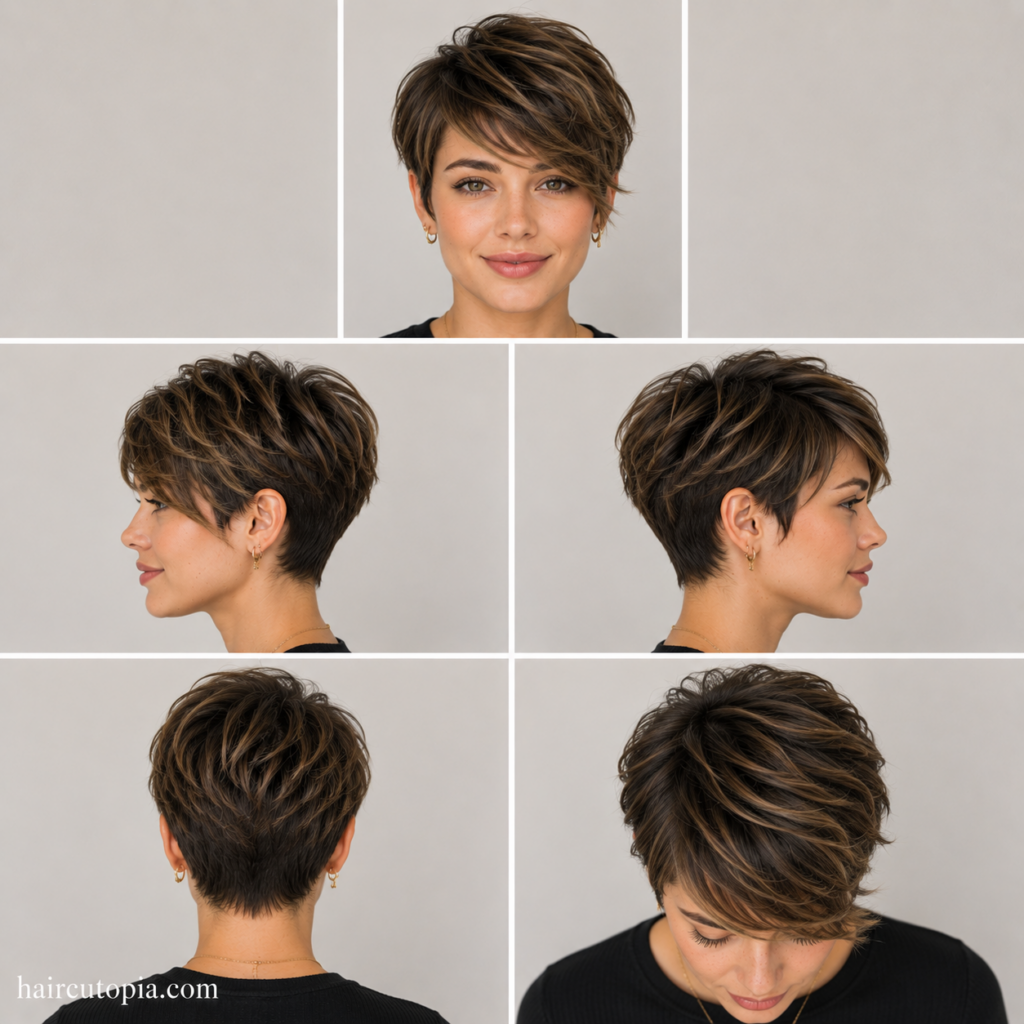
There’s no single correct length.
A better question is where you want the extra hair.
Longer on Top
Keeping most of the additional length through the top creates maximum styling flexibility while preserving short sides.
This works well for volume, waves, side-swept styling, and textured finishes.
Longer Through the Fringe
If you want softness around your face, preserving length through the bangs can make the biggest difference.
The rest of the haircut can remain relatively short.
This creates a dramatic contrast between the cropped back and longer front.
Longer Around the Sides
Leaving additional hair around the ears creates a softer silhouette.
The pieces may be long enough to tuck behind the ears or fall naturally along the cheekbones.
This starts moving the haircut slightly closer to bixie territory.
Longer Through the Back
Some long pixies preserve additional length at the neckline.
This creates a less tightly cropped finish and can make growing the haircut toward a bob easier.
The shape needs to remain intentional, though, so the back doesn’t simply look overgrown.
Long Pixie Haircuts for Fine Hair
A long pixie can work extremely well with fine hair because shorter lengths reduce the weight pulling the hair downward.
That can create more natural lift.
The challenge is maintaining enough density.
Too much layering or aggressive texturizing may make fine hair appear sparse.
Consider:
- Softly layered long pixies
- Side-swept pixies
- Tapered cuts
- Longer tops
- Lightly textured styles
A stronger shape around the sides can preserve fullness while strategic layers through the crown create movement.
When styling, lightweight products are usually best.
Heavy waxes, oils, and creams can quickly flatten fine short hair.
Long Pixie Haircuts for Thick Hair
Thick hair provides plenty of density for a long pixie.
It also creates plenty of volume.
Without internal shaping, the longer top and sides can become bulky as they grow.
Layering, tapering, and undercutting can help control that weight.
Thick hair works particularly well with:
- Textured long pixies
- Choppy pixies
- Undercut styles
- Shaggy pixies
- Layered cuts
The goal isn’t necessarily to remove as much hair as possible.
Strategic weight removal is more important than aggressive thinning.
Long Pixie Haircuts for Straight Hair
Straight hair shows the shape and layering of a long pixie clearly.
A smooth side-swept style can create a polished finish, while texturizing products can produce separation when you want something more relaxed.
Longer straight pixies can also benefit from crown layers that prevent the top from falling completely flat.
Depending on the cut, you can wear straight hair:
- Sleek
- Side-swept
- Brushed forward
- Tousled
- Slicked back
- Lifted at the roots
This styling flexibility is one of the biggest advantages of keeping extra length.
Long Pixie Haircuts for Wavy Hair
Natural waves are particularly well suited to long pixies.
There’s enough length for the wave pattern to form while the overall haircut remains short.
Soft layers can encourage movement through the top and fringe.
Remember that shortening wavy hair can make the wave pattern stronger.
Once the weight of longer hair disappears, the strands may spring upward.
Plan the finished length based on how your hair looks dry rather than only when it’s stretched.
Long Pixie Haircuts for Curly Hair
A long pixie gives curls enough room to develop while keeping the overall silhouette compact.
The sides can remain shorter while curls are preserved through the top.
Alternatively, more length can remain throughout for a softer, fuller shape.
Layer placement matters because it determines where volume develops.
Shrinkage is equally important.
A curl that appears several inches long when stretched may sit considerably higher once dry.
Discuss the finished dry shape with your stylist before cutting.
Long Pixie Haircuts for Coily Hair
Coily textures can create beautiful long-pixie shapes with plenty of natural volume.
A tapered approach can keep the sides controlled while preserving more length through the top.
The contrast between shorter sides and textured volume above can create a strong silhouette without requiring elaborate styling.
Moisture, shrinkage, and your preferred level of definition should all influence the cut.
Long Pixie Haircuts for Different Face Shapes
A long pixie can be customized extensively because the fringe and top provide more framing than a close crop.
Face shape can guide those details without becoming a strict rule.
Long Pixies for Oval Faces
Oval faces can experiment with most long-pixie shapes.
Side-swept fringe, curtain bangs, textured crowns, and sleeker styles can all work.
Texture and personal preference can lead the decision.
Long Pixies for Round Faces
Additional height through the crown can create a more vertical silhouette.
Side-swept fringe introduces diagonal movement around the face.
You can also take the opposite approach and embrace softer volume around the sides.
There’s no requirement that a haircut make a round face appear longer.
Long Pixies for Square Faces
Soft fringe and textured layers can contrast with a defined jawline.
A sleeker pixie can instead emphasize facial structure.
Longer pieces around the temples or ears can also soften the transition between the haircut and face.
Long Pixies for Heart-Shaped Faces
Longer bangs provide plenty of options for framing the forehead and cheekbones.
Side-swept or curtain-style fringe can create softness around the upper portion of the face.
Additional length around the ears can help balance the overall silhouette.
Long Pixies for Long Faces
Avoiding excessive height is one option if you don’t want to visually lengthen the face further.
Side-swept bangs, fuller sides, and textured fringe can create more horizontal emphasis.
The additional length of a long pixie makes these adjustments easier than they are with a very close crop.
Long Pixie Haircuts With Bangs
Bangs are one of the easiest ways to customize a long pixie, with different fringe lengths creating noticeably different proportions around the face.
Side-Swept Bangs
Long side-swept bangs create softness and movement.
They can be styled across the forehead, tucked away, or incorporated into the top.
This is one of the most versatile fringe options.
Wispy Bangs
Wispy bangs create lighter forehead coverage.
They work well when you want fringe without making the front of the haircut feel heavy.
Curtain Bangs
Short curtain bangs can create a center opening and gradually blend into the sides.
They pair naturally with layered and shaggy long pixies.
Choppy Bangs
Choppy fringe complements textured haircuts.
The uneven, separated finish can make styling easier because the bangs aren’t supposed to sit in one perfect line.
Long Dramatic Fringe
Keeping significantly more length through the front creates strong contrast with a cropped back and sides.
This provides maximum styling flexibility but may require more daily attention to keep the fringe sitting where you want it.
Long Pixie Haircuts With a Side Part
A side part is a natural match for longer pixies.
It allows more hair to sweep across one side and can create additional volume.
A deep side part makes the asymmetry more noticeable.
A softer side part creates a more balanced result.
If you have a natural cowlick near the hairline, working with its direction can make styling significantly easier.
Long Pixie Haircuts With a Middle Part
Middle parts are less common on very short pixies, but the additional length of a long pixie can make them possible.
The front sections can separate around the center and fall toward either side.
This works particularly well with curtain-style fringe and softer cuts that leave additional length around the ears.
Sleek vs. Textured Long Pixie Haircuts
A major advantage of keeping extra length is being able to change the finish.
A sleek long pixie emphasizes:
- Shape
- Shine
- Smoothness
- Direction
- Clean lines
A textured long pixie emphasizes:
- Movement
- Volume
- Separation
- Piecey layers
- Natural texture
You may be able to achieve both with the same haircut.
If that versatility matters, tell your stylist before cutting. Layer placement can influence whether the hair transitions easily between smooth and tousled styles.
How to Style a Long Pixie Haircut
Long pixies usually require less time than longer hairstyles, but the extra length provides more options than a traditional pixie.
Tousled Texture
Apply a small amount of lightweight styling product and use your fingers to create separation through the top.
Don’t try to make every section identical.
A little irregularity helps create the relaxed finish.
Side-Swept and Smooth
Direct the front across the forehead while drying.
A small amount of smoothing product can help control flyaways and emphasize the shape.
Crown Volume
Lift the roots through the crown while blow-drying.
Concentrate the volume toward the areas where the haircut has been designed to support it.
Slicked Back
Longer top sections can often be directed away from the face for a completely different look.
This puts more emphasis on the short sides and facial features.
Natural Waves
Encourage your existing wave pattern rather than straightening it away.
A lightweight curl or texture product may provide enough definition.
Defined Curls
For curly long pixies, apply styling products according to your curl pattern and allow the hair to dry without excessive disturbance.
The haircut itself should provide much of the overall shape.
Tucked Behind the Ear
If the sides are long enough, an ear tuck creates an easy change.
Tucking one side produces asymmetry.
Tucking both sides makes the haircut appear more compact and exposes more of the face.
Are Long Pixie Haircuts Low Maintenance?
Long pixies can be easier to maintain than very short precision pixies in some ways.
The additional length means a small amount of growth doesn’t always alter the haircut immediately.
Daily styling can also be simple if the cut works with your natural texture.
However, longer sections may require more styling than a close crop.
Side-swept bangs might need blow-drying. Crown volume may need product. Longer sides can develop awkward shapes if the haircut isn’t maintained.
Think about maintenance in two categories:
- Daily styling
- Salon upkeep
A good long pixie should balance both according to your routine.
How Often Should You Trim a Long Pixie?
Many long pixies can be trimmed approximately every 6–8 weeks.
That’s often slightly more forgiving than a very short pixie, which may need reshaping sooner.
The exact schedule depends on:
- Hair growth rate
- Fringe length
- Neckline
- Amount of tapering
- Layer placement
- Whether you’re maintaining or growing the cut
If you enjoy a softer, more grown-in shape, you may be comfortable waiting longer.
If you want the sides and neckline consistently precise, you’ll probably need more frequent appointments.
How to Ask Your Hairstylist for a Long Pixie
The phrase “long pixie” can describe many different haircuts.
Show reference photos and explain where you specifically want to preserve length.
Discuss:
- How short you want the sides.
- How short you want the back.
- How much length you want through the crown.
- Where your fringe should fall.
- Whether you want your ears exposed.
- How much layering or texture you prefer.
- Whether you want tapering or an undercut.
- How you normally style your hair.
Also explain what you’re trying to avoid.
If you don’t want the haircut to become too close to a bob, say so.
If you don’t want the sides extremely short, mention that as well.
Clear boundaries can be just as useful as inspiration photos.
Going From Long Hair to a Long Pixie
A long pixie can be a more approachable choice than going directly from long hair to a close crop.
You’ll still experience a dramatic transformation, but the extra length provides some familiar movement around the face.
Long fringe can be especially helpful during the adjustment.
You can style it differently from day to day rather than feeling locked into one short shape.
Still, remember that many of your old styling habits will disappear.
You probably won’t be able to create a ponytail or bun.
Instead, you’ll rely more on:
- Parting
- Texture
- Volume
- Fringe placement
- Hair accessories
- Styling products
If you’re unsure about the final length, ask your stylist to begin slightly longer.
You can always shorten it after seeing how the first version feels.
Growing Out a Long Pixie
A long pixie is already well positioned for growing into a bixie or bob.
The key is controlling the sides and back while the rest catches up.
The progression may look something like:
Long pixie → bixie → short bob → classic bob.
During this process, occasional trims can prevent the neckline from becoming overly heavy.
Your stylist may also gradually adjust the layers so the haircut develops a stronger perimeter, eventually allowing the shape to transition into a short bob as enough length develops around the sides and back.
From there, continued growth can move the shape toward a more traditional bob haircut with a more established perimeter around the head.
If growing is the goal, make that clear at every appointment.
You don’t want each trim to recreate the original pixie and remove the progress you’ve made.
Who Should Consider a Long Pixie?
A long pixie may be particularly appealing if you:
- Want short hair without an extremely close crop
- Prefer more styling flexibility than a classic pixie
- Like side-swept or longer bangs
- Want to work with natural waves or curls
- Are transitioning from long hair to short hair
- Are growing out a shorter pixie
- Want a style with less weight than a bob
- Like textured, tousled hairstyles
- Want a cut that can look polished or relaxed
The extra length makes the long pixie one of the more adaptable short haircuts.
Common Long Pixie Haircut Mistakes to Avoid
A little planning can make the difference between a long pixie you love and one that’s difficult to style.
Leaving Length Everywhere
A long pixie still needs structure.
If every section is simply left longer, the haircut can lose its pixie shape and appear overgrown.
Length should be preserved intentionally.
Removing Too Much From Fine Hair
Heavy texturizing can reduce fullness.
Fine hair often needs a careful balance between movement and density.
Ignoring Growth Patterns
Cowlicks matter much more when the hair is short.
A long fringe that naturally wants to move in the opposite direction can become frustrating to style every morning.
Choosing a Style That Requires Too Much Styling
If you normally spend five minutes on your hair, choose a long pixie that can work within that routine.
Don’t rely on daily salon-level blowouts to make the haircut work.
Forgetting About the Back
It’s easy to focus entirely on the front because that’s what you see in the mirror.
The neckline and back shape are equally important to the overall haircut.
Frequently Asked Questions About Long Pixie Haircuts
What is a long pixie haircut?
A long pixie is a short haircut that preserves additional length through areas such as the top, crown, fringe, or sides while maintaining the overall structure of a pixie.
How long is a long pixie?
There is no exact required measurement.
The hair is generally longer than a traditional pixie but still noticeably shorter and more cropped than a bob.
What is the difference between a long pixie and a bixie?
A long pixie maintains more of a cropped pixie structure, while a bixie incorporates additional bob-like length and fullness around the sides and back.
Are long pixie cuts good for fine hair?
Yes.
Shorter overall length can reduce weight and create lift, while carefully placed layers can add movement. Excessive texturizing should usually be avoided when preserving fullness is important.
Are long pixies good for thick hair?
Yes.
Thick hair provides plenty of density for textured and layered styles. Strategic tapering, layering, or undercutting can help control bulk.
Can curly hair have a long pixie?
Absolutely.
The additional length gives curls room to form while maintaining a short overall silhouette. Shrinkage should be considered carefully.
Can a long pixie have bangs?
Yes.
Long pixies work particularly well with side-swept, curtain, wispy, choppy, and longer dramatic fringe.
How often should a long pixie be trimmed?
Around every 6–8 weeks works for many long pixies, although the schedule depends on growth rate and how precise you want the haircut to remain.
Is a long pixie easier to grow out than a short pixie?
It can be.
Because the haircut already has additional length, it’s closer to the proportions of a bixie or short bob.
Can you style a long pixie in different ways?
Yes.
Depending on the length, you may be able to wear it sleek, textured, side-swept, voluminous, slicked back, naturally wavy, curly, or tucked behind the ears.
Is a long pixie high maintenance?
Not necessarily.
Daily styling can be quick, especially when the cut works with your natural texture. However, regular trims are usually needed to maintain the intended shape.
Final Thoughts on Long Pixie Haircuts
A long pixie gives you something that very short hair doesn’t always provide: room to change your mind from one morning to the next.
Wear the fringe across your forehead today. Push it back tomorrow. Add texture through the crown, tuck one side behind your ear, smooth everything down, or let your natural waves and curls create the shape.
That extra length creates options without taking away the lightness of a short haircut.
The key is making sure the length is intentional.
A long pixie shouldn’t simply look like a regular pixie that hasn’t been cut recently. The top, sides, fringe, and neckline need to work together to create a deliberate silhouette.
Think about which areas you want longer, how much styling you’re willing to do, and whether you’re maintaining the haircut or eventually growing it toward a bixie or bob.
Get those details right, and a long pixie can offer an ideal balance between cropped and versatile.