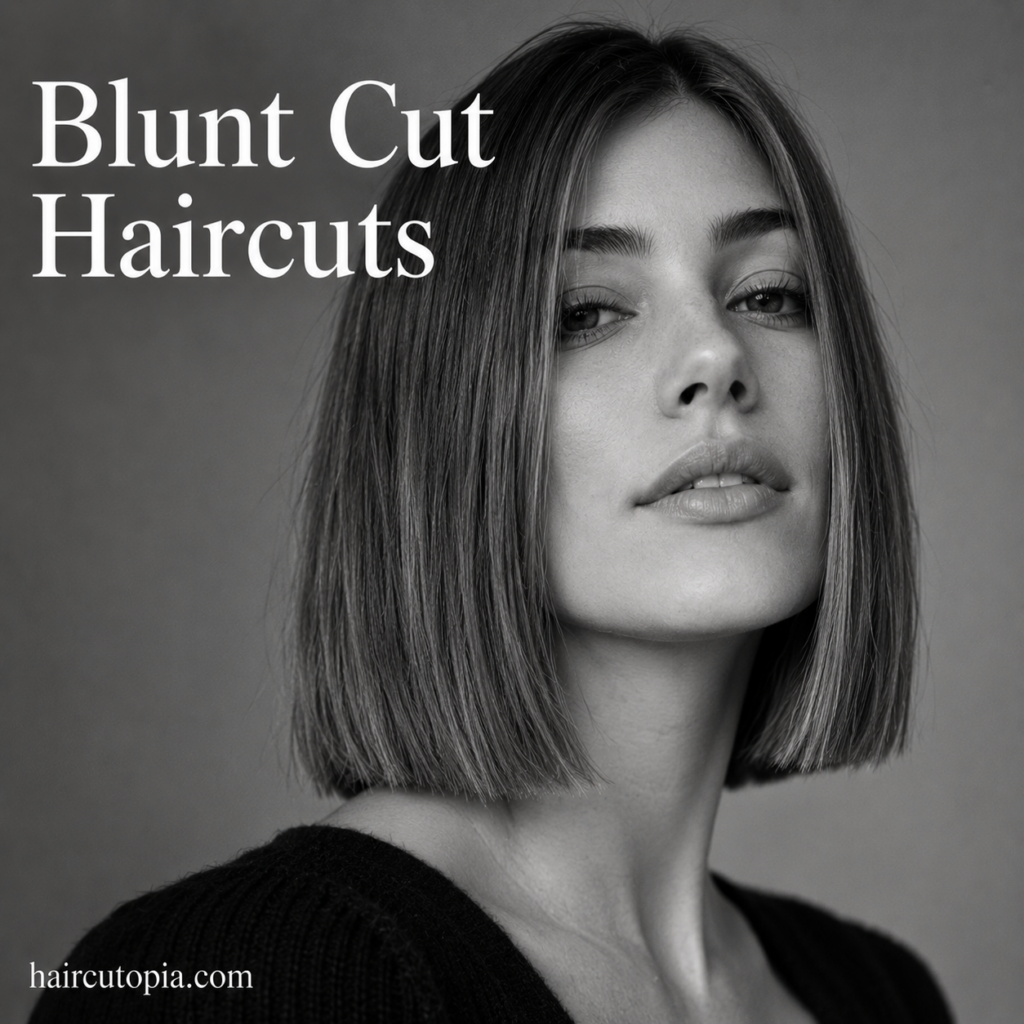
A blunt cut is one of those haircuts that looks simple until you notice how much the shape changes everything.
Instead of relying on lots of layers for movement, a blunt haircut puts the focus on the perimeter. The ends are cut to create a strong, relatively uniform line, giving the hair a clean and intentional finish.
That line can sit almost anywhere.
A short blunt bob can end around the jaw. A shoulder-length blunt cut creates a stronger silhouette without going particularly short. A long blunt haircut keeps plenty of length while making the ends look substantial and defined.
And despite the name, a blunt cut doesn’t have to look severe.
It can be polished and sleek, soft and slightly tousled, naturally wavy, or full of texture. You can add bangs or subtle face framing while keeping the main perimeter strong.
The key is deciding how much structure you want.
If you’re considering a blunt haircut, here’s what to know about length, texture, density, styling, maintenance, and choosing a version that works with your hair.
What Is a Blunt Cut Haircut?
A blunt cut is a haircut in which the ends are cut to create a strong, relatively even perimeter.
Instead of using numerous layers to create different lengths throughout the hair, the main shape stays close to one length.
That creates a visually fuller edge.
Blunt haircuts may be:
- Short
- Chin length
- Jaw length
- Shoulder length
- Collarbone length
- Medium length
- Long
They can also be worn with different textures.
Straight hair makes the perimeter especially obvious, but wavy, curly, and coily hair can all use a blunt or minimally layered shape.
The defining feature isn’t that every individual strand must be exactly the same length.
It’s the appearance of a strong perimeter.
What Does a Blunt Haircut Look Like?
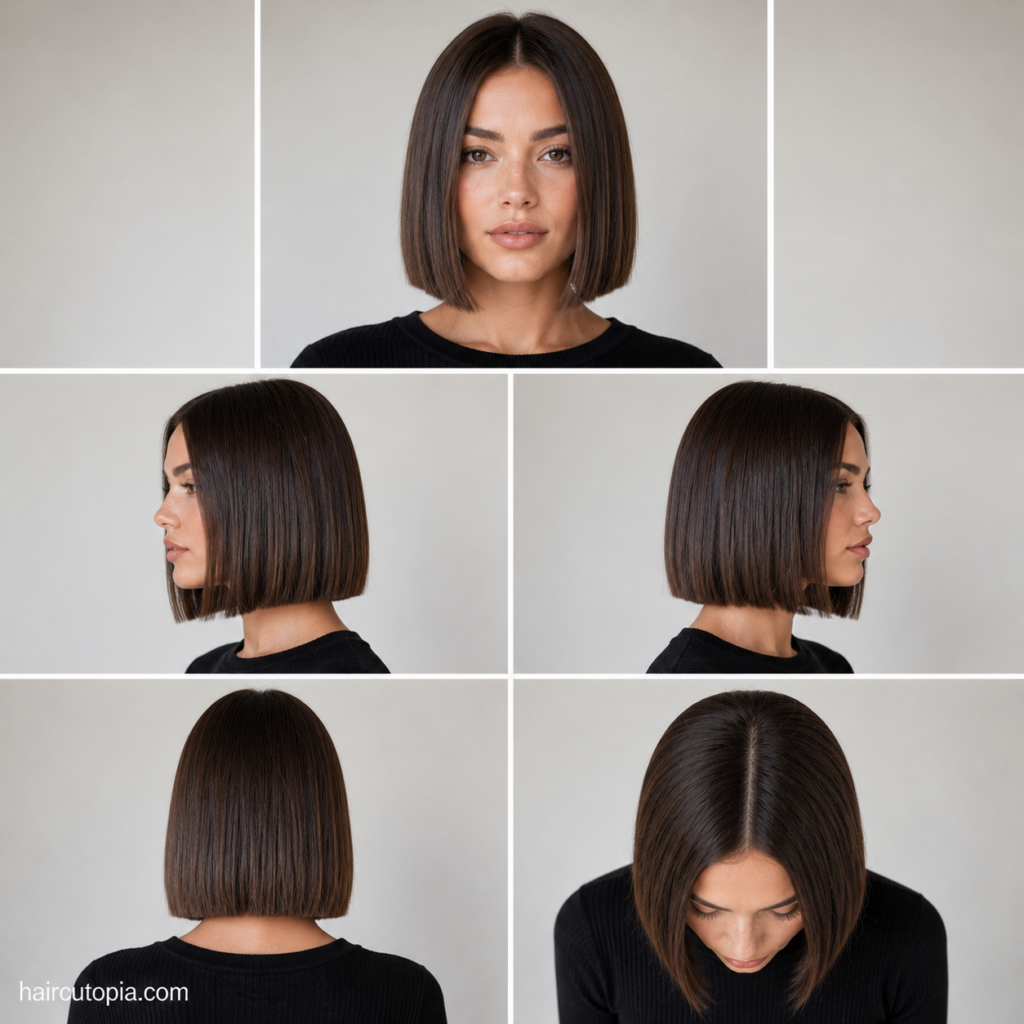
A classic blunt haircut has a solid-looking baseline.
From the back, the ends may form a straight or subtly curved line.
From the sides, the haircut usually maintains substantial density through the ends rather than tapering into numerous layers.
The result often looks:
- Clean
- Full
- Structured
- Polished
- Intentional
Styling can soften that appearance considerably.
Loose waves can make a blunt haircut look relaxed while the strong perimeter remains visible underneath.
Why Choose a Blunt Cut?
Among women’s haircuts, blunt cuts stand out for their emphasis on fullness, structure, and a strong perimeter rather than extensive layering.
Layering removes some length and weight from different sections of the hair. A blunt cut preserves more of that density toward the bottom.
This can make the ends appear thicker.
You might consider a blunt cut if you:
- Prefer a strong haircut shape
- Want fuller-looking ends
- Have fine hair
- Want fewer layers
- Like sleek styling
- Want a simple perimeter
- Prefer an easy-to-understand haircut
- Are growing out layers
- Want damaged or thin ends removed
- Like bobs and lobs with clean lines
Blunt cuts can also provide a useful reset after heavily layered hair.
As shorter layers grow, maintaining a stronger perimeter can gradually move the haircut closer to one length.
Popular Types of Blunt Cut Haircuts
A blunt cut is more of a cutting approach than one specific hairstyle.
Changing the overall length creates very different results.
Short Blunt Cut
A short blunt cut usually ends somewhere between the ears and jaw.
At these compact lengths, the style often overlaps with a short bob, especially when the perimeter remains strong around the jaw or chin.
The compact length makes the perimeter particularly noticeable.
Short blunt hair can look sleek and precise, but it can also be worn with natural texture.
Because the haircut has less weight, waves and curls may become more pronounced after cutting.
Blunt Bob
The blunt bob is one of the most recognizable versions of the haircut.
It generally falls somewhere around the jaw or chin and maintains a strong baseline.
A blunt bob can be:
- Sleek
- Straight
- Wavy
- Center-parted
- Side-parted
- Worn with bangs
Small differences in length can dramatically change how the bob sits around the jaw and neck.
Chin-Length Blunt Cut
A chin-length blunt cut creates a clear horizontal shape around the lower face.
It provides the compact appearance of a bob while keeping enough length for several styling options.
The ends can be worn perfectly straight or slightly bent for a softer finish.
Jaw-Length Blunt Cut
A jaw-length cut sits slightly higher than many traditional chin-length bobs.
This creates a compact, defined silhouette.
Because the perimeter falls close to the jawline, precise placement becomes especially noticeable.
Even a small change in length can alter the finished shape.
Shoulder-Length Blunt Cut
Shoulder-length blunt hair offers more versatility.
It’s long enough for ponytails and many updos while still maintaining a visible, substantial perimeter.
One thing to consider is where the ends hit the shoulders.
Hair that lands directly on them may naturally flip outward.
Cutting slightly above or below that point can change how the ends behave.
Collarbone Blunt Cut
A collarbone-length blunt cut sits between a bob and longer medium hair.
It preserves a clean baseline while providing more movement than a shorter blunt bob.
This length is useful if you want a noticeable haircut without committing to short hair.
Medium Blunt Cut
Medium blunt cuts generally fall between the shoulders and upper chest.
At this length, the haircut maintains a strong perimeter but has enough weight to move naturally.
It can be worn straight, wavy, or with soft bends through the lengths.
Long Blunt Cut
Long hair can also have a blunt perimeter.
Instead of tapering into long layers or a heavily textured edge, the bottom remains full and defined.
A long blunt haircut is particularly useful when you want to maintain length while making thin or uneven ends look stronger.
The longer the hair becomes, the less visually dramatic the blunt line may appear from the front.
From the back, however, the solid perimeter can still be very noticeable.
Blunt Cuts at Different Lengths
Length changes more than the appearance of a blunt haircut.
It also changes how the hair moves and how easy it is to style.
Above-the-Chin Blunt Cut
Very short blunt cuts create a graphic, compact shape.
The ends don’t have much weight, so natural texture may become more noticeable.
This length also exposes more of the neck.
Chin-Length Blunt Cut
Chin length creates the classic short-bob territory.
The perimeter becomes a major part of the overall style.
Shoulder-Length Blunt Cut
Shoulder length provides a balance between structure and versatility.
You can maintain a strong edge without committing to short hair.
Collarbone-Length Blunt Cut
Collarbone length offers enough weight for a smoother fall while still looking clearly shaped.
It’s also relatively easy to tie back.
Long Blunt Cut
Long blunt hair emphasizes density through the ends.
The haircut can remain simple while looking deliberately finished.
Blunt Cut With No Layers
A true one-length blunt cut uses little to no visible layering.
The hair falls toward one main perimeter.
This creates maximum density through the bottom.
It’s particularly appealing if you want:
- Full-looking ends
- A simple silhouette
- Minimal internal movement
- A sleek finish
- Easy grow-out
However, completely avoiding layers can create significant weight in very thick hair.
Whether that’s desirable depends on your texture and the shape you want.
Blunt Cut With Minimal Layers
You can maintain a blunt perimeter while adding a small amount of internal movement.
This is useful when you like the full edge but don’t want the haircut to feel too heavy.
Minimal layering might include:
- Subtle internal weight removal
- Very long invisible layers
- Gentle face framing
- Light movement near the front
From the outside, the perimeter can still look blunt.
This approach gives you some flexibility without turning the haircut into a clearly layered style.
Blunt Cut With Face-Framing Layers
Face-framing layers and a blunt perimeter can work together, creating movement around the front while preserving fuller-looking ends through the main lengths.
The shorter pieces remain concentrated around the front while the back and main lengths maintain a strong baseline.
This creates a useful balance.
Face framing might begin around the:
- Cheekbones
- Jaw
- Chin
- Collarbone
Longer face framing keeps the overall haircut closer to a one-length appearance.
Shorter pieces create more contrast.
Blunt Cut With Bangs
Bangs can make a blunt haircut feel even more defined or provide a softer contrast, depending on the fringe style.
Possible combinations include:
- Blunt cut with blunt bangs
- Blunt cut with wispy bangs
- Blunt cut with curtain bangs
- Blunt cut with side-swept bangs
- Blunt cut with micro bangs
Blunt bangs reinforce the structured character of the haircut.
Wispy or curtain fringe can soften it.
The rest of the hair doesn’t need to be layered simply because bangs are added.
Blunt Cut With Curtain Bangs
Curtain bangs create movement around the front while the main haircut remains solid through the ends.
This is a good combination if you like the fullness of a blunt cut but want more shape around your face.
Longer curtain bangs can transition into subtle face-framing pieces without affecting the back perimeter.
The contrast can be especially noticeable on medium and long blunt hair.
Blunt Cuts for Fine Hair
Fine hair is often associated with blunt cuts for a practical reason: maintaining more hair at the same general length can make the perimeter appear fuller.
When numerous layers are added to fine or low-density hair, the ends can sometimes look sparse.
A blunt shape preserves more density.
Fine hair may benefit from:
- A strong perimeter
- Minimal layering
- Limited thinning
- Lightweight styling
- Strategic face framing
Short and medium blunt cuts can create an especially substantial appearance because there is less length weighing the hair down.
That doesn’t mean every person with fine hair needs a blunt cut.
If you love movement and layers, you can still have them.
The question is how much density you’re comfortable removing.
Blunt Cuts for Thick Hair
Thick hair can create a dramatic blunt shape.
The density naturally produces a substantial perimeter.
However, completely one-length thick hair can also become heavy.
Depending on your texture, your stylist may use subtle internal techniques to manage bulk while preserving the exterior line.
The goal is to keep the haircut looking blunt without creating more weight than you want.
Thick blunt hair can work especially well at:
- Chin length
- Shoulder length
- Collarbone length
- Medium lengths
Long thick hair can also maintain a blunt perimeter, although the overall weight may become significant.
Blunt Cuts for Straight Hair
Straight hair displays a blunt line very clearly.
There are no waves or curls obscuring the perimeter, so precision becomes particularly noticeable.
Straight blunt hair can look extremely sleek.
It can also reveal small inconsistencies in the baseline more easily than textured hair.
Styling options include:
- Pin straight
- Slightly curved under
- Ends flipped outward
- Soft bends
- Tucked behind the ears
Even simple changes to the ends can make the same haircut feel different.
Blunt Cuts for Wavy Hair
Wavy hair softens a blunt perimeter naturally.
The baseline is still full, but the individual strands don’t necessarily form one perfectly visible horizontal line.
This creates a more relaxed appearance.
A blunt cut can also give wavy hair a strong foundation.
Because fewer layers are removing weight, the waves may stretch somewhat compared with a heavily layered haircut.
Shorter blunt cuts may behave differently.
Removing length reduces weight, which can allow the wave pattern to become stronger.
Blunt Cuts for Curly Hair
Curly hair can absolutely have a blunt-inspired shape.
The finished perimeter won’t necessarily look like a ruler-straight line.
Instead, the overall silhouette maintains fullness through the bottom with minimal graduation.
Curl patterns and shrinkage make the final dry shape especially important.
A stylist may need to account for individual curls that spring to different lengths.
A curly blunt cut can create:
- A full perimeter
- Strong overall shape
- Substantial volume
- Minimal visible layering
If you want more volume through the crown, some layering may still be useful.
Blunt Cuts for Coily Hair
Coily hair can create a beautifully strong silhouette with a fuller perimeter.
As with curly hair, “blunt” doesn’t mean every coil ends at exactly the same visible point.
The goal is a cohesive outer shape with less obvious layering.
Density, shrinkage, and volume distribution all matter.
A blunt-inspired coily haircut can be shaped to maintain fullness while still allowing enough internal movement for the hair to sit comfortably.
Blunt Cuts for Thin or Low-Density Hair
Hair density and strand thickness aren’t the same thing.
You can have fine strands with lots of hair or thicker strands with relatively low density.
If your overall density is low, preserving the perimeter becomes especially important.
A blunt cut can reduce the appearance of thin, tapered ends.
Consider:
- Keeping layers minimal
- Avoiding excessive thinning
- Choosing a manageable length
- Maintaining the ends regularly
Cutting several inches of very sparse ends can sometimes make the remaining hair appear noticeably fuller even though the hair is technically shorter.
Blunt Cuts for Different Face Shapes
You don’t need a specific face shape to wear a blunt haircut.
The overall length and front pieces influence the appearance more than the word “blunt.”
Blunt Cuts for Oval Faces
Oval faces can experiment with virtually any blunt length.
A short bob creates a compact shape, while shoulder and long versions emphasize the hair’s perimeter rather than the face itself.
Blunt Cuts for Round Faces
A chin, collarbone, medium, or long blunt cut can all work.
Longer lengths create more vertical movement, while shorter bobs place more emphasis around the jaw and cheeks.
Choose based on the silhouette you prefer rather than trying to follow a rule about making the face appear narrower.
Blunt Cuts for Square Faces
A blunt perimeter can complement a defined jaw with equally strong haircut lines.
If you prefer a softer effect, waves or subtle face framing can reduce the visual sharpness without sacrificing the main perimeter.
Blunt Cuts for Heart-Shaped Faces
Chin and jaw-length blunt cuts can place visual weight around the lower face.
Longer versions create a completely different effect.
Bangs or face framing can further adjust where the haircut draws attention.
Blunt Cuts for Long Faces
Short and medium blunt cuts can create noticeable horizontal structure.
Long versions maintain more vertical length.
Bangs can add another horizontal element if that’s the look you want.
Blunt Bob Haircuts
The blunt bob deserves special attention because the strong perimeter is particularly visible at shorter lengths.
A classic blunt bob usually:
- Falls around the jaw or chin
- Uses minimal layering
- Maintains a full baseline
- Creates a compact silhouette
But the styling doesn’t have to be rigid.
A blunt bob can be worn:
- Straight and polished
- Softly waved
- Tousled
- Tucked behind one ear
- Center-parted
- Side-parted
The cut provides the structure.
The styling determines how polished or relaxed that structure appears.
Blunt Lob Haircuts
A blunt lob provides the same strong perimeter at a longer length.
Most versions fall around the shoulders or collarbone.
This makes the haircut easier to tie back while preserving the visual impact of a solid baseline.
A blunt lob can be a good middle ground if you want:
- Fuller ends
- Medium length
- Minimal layers
- Styling versatility
- Easier grow-out
Loose waves are especially effective on a blunt lob because they add movement without hiding the strong ends completely.
Long Blunt Haircuts
Long blunt hair focuses on maintaining density at the bottom.
Instead of gradually tapering into multiple layers, the lengths reach a fuller perimeter.
This works particularly well when long hair has become thin or uneven through the ends.
A trim can remove the most transparent sections and create a stronger baseline.
Long blunt hair can still include:
- Bangs
- Face framing
- Subtle internal layers
- Natural texture
The main requirement is preserving the appearance of a substantial perimeter.
Blunt Cut vs. Layered Haircut
The main difference is where the lengths are distributed.
A blunt haircut keeps most of the hair close to the same overall length.
A layered haircut introduces shorter sections throughout the hair to create movement and redistribute weight.
Blunt cuts generally emphasize:
- Fullness
- Weight
- Strong ends
- A clean perimeter
Layered cuts generally emphasize:
- Movement
- Texture
- Volume distribution
- Multiple lengths
Neither approach is universally better.
Fine hair may benefit from the density of a blunt perimeter, while thick hair may appreciate the weight removal provided by layers.
Many haircuts combine both techniques.
Blunt Cut vs. One-Length Haircut
These terms are often used interchangeably, but there can be a subtle distinction.
A one-length haircut describes how the hair is distributed: most sections reach the same general perimeter.
A blunt cut describes the strong visual quality of that perimeter.
Most classic one-length cuts look blunt.
However, a stylist can preserve an apparently blunt exterior while using subtle internal techniques that prevent the haircut from being technically one length everywhere.
For most people choosing a hairstyle, the visual result matters more than the terminology.
Blunt Cut vs. Bob
A bob haircut describes the length and overall hairstyle, while a blunt cut describes the perimeter and cutting approach.
That means a bob can be blunt or layered.
Likewise, a blunt haircut can be much longer than a bob.
A blunt bob combines both ideas:
- Bob-length hair
- Strong perimeter
- Minimal visible layering
Understanding the distinction makes it easier to describe exactly what you want at the salon.
Blunt Cut vs. Lob
A lob is a longer bob that typically falls around the shoulders or collarbone, but it doesn’t automatically have a blunt perimeter.
Some lobs are heavily layered.
Others maintain a strong baseline.
A blunt lob combines the longer bob length with minimal visible layering and fuller ends.
Blunt Cut vs. U-Shaped Haircut
A blunt cut generally creates a stronger, straighter perimeter.
A U-shaped haircut curves gradually downward toward the center of the back.
The U shape can preserve substantial fullness while creating a softer outline.
From the front, the difference may not always be obvious.
From the back, it’s much easier to see.
Choose a blunt perimeter if you want a stronger baseline.
Choose a U shape if you prefer a gradual curve through the back.
Blunt Cut vs. V-Shaped Haircut
A V-shaped haircut becomes progressively longer toward the center back.
This creates a pointed or tapered outline.
A blunt cut does the opposite visually.
Instead of emphasizing a central point, it creates a fuller and more uniform baseline.
V-shaped cuts can showcase long layers and movement.
Blunt cuts emphasize density through the ends.
How to Style a Blunt Cut
Blunt cuts can be much more versatile than their structured shape suggests.
Sleek and Straight
Straight styling emphasizes the precision of the perimeter.
Use heat protectant before applying hot tools and keep the ends smooth.
Soft Waves
Loose waves break up the strong shape and create movement.
Leaving the very ends slightly straighter can help preserve the visual impact of the blunt baseline.
Natural Texture
You don’t need to smooth a blunt haircut.
Allowing waves, curls, or coils to dry naturally creates a softer interpretation of the shape.
Ends Curved Under
A slight inward bend creates a polished, rounded finish.
This works particularly well with bobs and shoulder-length cuts.
Flipped Ends
Directing the ends outward gives a blunt haircut a more playful shape.
Shoulder-length hair may naturally do this when it hits the shoulders.
Wet-Look Styling
A sleek, controlled finish can emphasize the haircut’s graphic shape.
This tends to work particularly well with short and medium blunt cuts.
What Products Work Well for Blunt Haircuts?
Product choice should depend on your texture and styling goal rather than the haircut alone.
Useful options may include:
- Heat protectant
- Smoothing cream
- Lightweight serum
- Volumizing mousse
- Texture spray
- Curl cream
- Anti-frizz product
- Flexible-hold hairspray
Fine hair usually benefits from lighter products that won’t collapse the shape.
Thicker or more textured hair may need additional moisture or smoothing.
Apply heavier products primarily through the lengths and ends rather than automatically loading the roots.
Are Blunt Cuts Low Maintenance?
Blunt cuts can be simple to style, but the perimeter needs maintenance if you want it to stay sharp.
The cleaner the line, the easier it is to notice when the ends begin growing unevenly.
Short blunt bobs typically need more frequent reshaping than long blunt cuts.
A longer haircut can grow several inches without dramatically changing its overall identity.
Natural texture also makes small differences in the perimeter less obvious than very straight, sleek styling.
So a blunt cut can be low maintenance, but it depends on how precise you want it to look.
How Often Should a Blunt Cut Be Trimmed?
A short, precise blunt cut may benefit from trimming approximately every 6–8 weeks.
Medium blunt hair may go around 8–12 weeks.
Long blunt hair can often go longer depending on the condition of the ends.
Your schedule should consider:
- Hair length
- Growth rate
- Heat styling
- Split ends
- Desired precision
- Hair texture
You don’t need to follow a rigid calendar.
If the perimeter still looks healthy and maintains the shape you like, you may be able to wait longer.
How to Ask Your Hairstylist for a Blunt Cut
Be specific about both the length and the perimeter.
You might say you want:
- A strong, full baseline
- Minimal visible layering
- Fuller-looking ends
- A one-length appearance
- No heavy texturizing
- Optional subtle face framing
Then discuss where you want the perimeter to fall.
For example:
- At the jaw
- At the chin
- Above the shoulders
- At the collarbone
- Below the shoulders
Bring reference photos showing both the front and back.
The back view is especially important for blunt cuts because it clearly shows the perimeter shape.
Also tell your stylist how you normally wear your hair.
A haircut that looks perfectly straight when flat-ironed may behave differently when air-dried.
Growing Out a Blunt Cut
Blunt cuts generally grow out well because there aren’t many shorter layers changing the silhouette.
As the hair gains length, the perimeter simply moves lower.
Short bobs become longer bobs.
Longer bobs reach the shoulders.
Shoulder-length hair moves toward medium and long lengths.
The main challenge is keeping the ends healthy and relatively even.
Regular small trims can maintain the blunt appearance during the process.
If you’re growing out layers into a blunt cut, it takes longer.
The shortest layers need time to catch up before the haircut can become truly one length.
In the meantime, maintaining a stronger bottom perimeter can gradually improve the overall shape.
Who Should Consider a Blunt Cut?
A blunt haircut may be a good choice if you:
- Want fuller-looking ends
- Prefer minimal layering
- Like strong haircut shapes
- Have fine or low-density hair
- Want to remove thin ends
- Prefer sleek styling
- Want an easy grow-out
- Are growing out layers
- Like bobs or lobs
- Want a haircut that looks deliberate without complicated layering
You don’t need straight hair or a particular face shape.
The blunt perimeter can be adapted to different lengths, densities, and natural textures.
Common Blunt Cut Mistakes to Avoid
A simple haircut still requires careful planning.
Choosing the Wrong Shoulder Length
Hair ending directly on the shoulders may flip outward.
If you don’t want that effect, consider going slightly shorter or longer.
Removing Too Much Internal Weight From Fine Hair
Excessive thinning can undermine the fullness you wanted from a blunt cut in the first place.
Avoiding All Weight Removal on Very Thick Hair
Preserving the perimeter doesn’t always mean every strand must remain one length.
Subtle internal adjustments can make thick hair easier to manage.
Expecting Wavy or Curly Hair to Form a Perfect Straight Line
The perimeter should be judged according to the natural texture and overall silhouette.
Ignoring the Back View
The back is where the blunt line is often most visible.
Use reference photos that show more than the front.
Adding Too Many Layers
If your goal is a distinctly blunt appearance, extensive layering will change the character of the haircut.
Choosing Length Based Only on a Styled Photo
Consider where the haircut falls when natural, especially if your hair shrinks, waves, curls, or flips at the shoulders.
Frequently Asked Questions About Blunt Cut Haircuts
What is a blunt cut?
A blunt cut is a haircut with a strong, relatively uniform perimeter and minimal visible layering through the ends.
Does a blunt cut have to be short?
No.
Blunt cuts can range from short bobs to very long hair.
Is a blunt cut the same as a bob?
No.
A bob describes a shorter haircut length, while blunt describes the perimeter. A bob can be blunt or layered.
Is a blunt cut good for fine hair?
It can be an excellent option because preserving more hair through the perimeter can make the ends appear fuller.
Is a blunt cut good for thick hair?
Yes, although very thick hair may benefit from subtle internal weight management while preserving the strong exterior line.
Can wavy hair have a blunt cut?
Yes.
Natural waves soften the appearance of the perimeter while maintaining fullness through the ends.
Can curly hair have a blunt cut?
Yes.
The finished shape should be evaluated according to the dry curl pattern rather than expecting every curl to create an identical horizontal line.
Can you have layers with a blunt cut?
Yes.
Subtle internal layers, long layers, or face framing can be combined with a strong blunt perimeter.
Can you have bangs with a blunt cut?
Absolutely.
Blunt, wispy, curtain, side-swept, micro, and other bang styles can all be paired with a blunt haircut.
Does a blunt cut make hair look thicker?
A strong perimeter can make the ends appear fuller because fewer sections are shortened through layering.
Are blunt cuts high maintenance?
It depends on the length and desired precision. Short, sleek blunt cuts usually require more frequent reshaping than longer versions.
How often should a blunt haircut be trimmed?
Short precise cuts may need attention around every 6–8 weeks, while medium and long blunt cuts can often go longer.
Is a blunt cut good for growing hair out?
Yes.
The simple perimeter generally grows predictably and can help maintain fuller-looking ends while gaining length.
What’s the difference between a blunt cut and layered hair?
Blunt cuts emphasize a strong perimeter and similar overall lengths. Layered cuts introduce shorter sections throughout the hair to create more movement and redistribute weight.
Can a blunt haircut have face-framing layers?
Yes.
Face framing can be concentrated around the front while the main perimeter remains blunt.
Final Thoughts on Blunt Cut Haircuts
A blunt haircut proves that a style doesn’t need dozens of layers to have shape.
Sometimes the perimeter is the shape.
Keeping the ends full and relatively uniform can give fine hair a more substantial appearance, create a strong silhouette on thick hair, or simply make long ends look healthier and more intentional.
The length determines how dramatic that effect becomes.
A jaw or chin-length blunt bob puts the perimeter front and center. Shoulder and collarbone cuts offer more versatility while keeping the strong baseline. Long blunt hair provides a subtler version that focuses on maintaining density through the ends.
And you don’t have to choose between completely blunt hair and movement.
Face-framing pieces, bangs, subtle internal layers, waves, curls, and natural texture can all soften the haircut without eliminating its defining perimeter.
The important part is knowing what you want to preserve.
If fullness through the ends is the priority, keep the layering minimal. If thick hair feels too heavy, discuss subtle internal weight removal rather than immediately adding obvious layers everywhere.
A good blunt cut should look intentional whether you wear it sleek, waved, or naturally textured.
Simple doesn’t have to mean boring.
With the right length and a clean perimeter, that simplicity can be exactly what gives the haircut its impact.

Related Posts
 Haircuts for Straight Hair: The Complete Guide to Cuts for Every Length and Hair Type
 Pixie Haircuts for Fine Hair: 25 Flattering Styles That Add Volume and Texture
 Low Maintenance Bob Haircuts: 25 Easy Styles That Always Look Good
 Shag Haircuts for Frizzy Hair: 25 Styles That Embrace Texture While Reducing Bulk