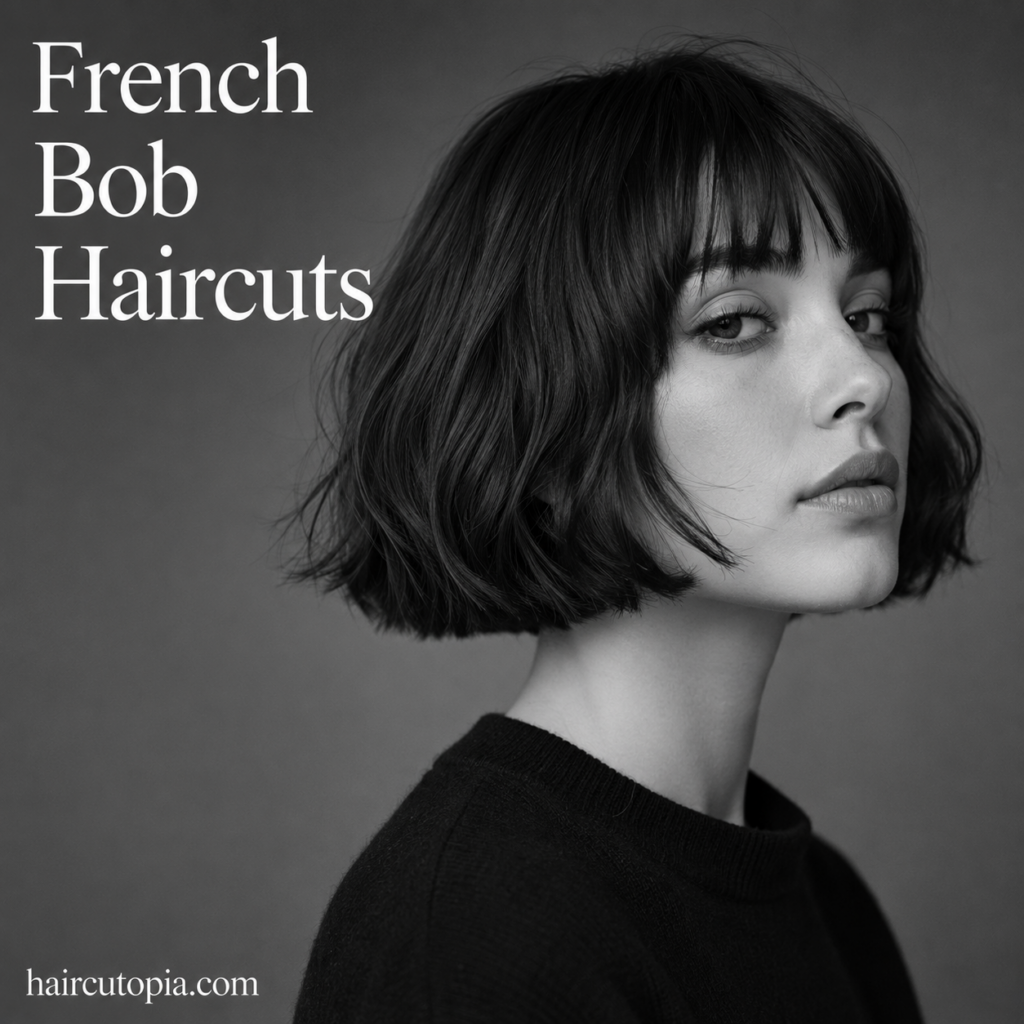
The French bob has a way of looking polished without looking like you spent an hour making it perfect.
That’s a big part of its appeal.
Typically cut somewhere around the jaw, chin, or slightly above, the French bob is shorter than many classic bobs and often paired with bangs. The shape can be blunt and graphic, softly textured, naturally wavy, or slightly tousled.
It doesn’t need to be perfectly smooth.
In fact, a little movement often makes the haircut more interesting.
The shorter length exposes the neck and puts more attention on the face, while bangs or soft front pieces can completely change the overall mood. A sleek French bob with blunt bangs feels very different from a wavy version with wispy fringe, even though both belong to the same general family.
And despite its recognizable look, there isn’t one exact formula.
You can adapt a French bob to straight, wavy, curly, fine, or thick hair. You can wear it with or without bangs. You can keep the perimeter strong or add subtle texture.
If you’re considering going shorter, here’s what to know about French bob haircuts, including lengths, fringe options, texture, styling, maintenance, and choosing a version that works with your hair.
What Is a French Bob Haircut?
A French bob is a shorter variation of the classic bob haircut that generally falls around the jaw or chin and often includes bangs or fringe.
Traditional versions tend to have a compact silhouette with a relatively strong perimeter.
Modern French bobs can be much softer.
Common characteristics include:
- Jaw- or chin-length hair
- A short, compact shape
- Blunt or softly textured ends
- Bangs or fringe
- Natural-looking movement
- Minimal or subtle layering
- A slightly undone finish
Not every French bob needs all of these features.
The defining idea is a shorter bob with an intentional shape that frames the face and leaves the neck relatively exposed.
How Short Is a French Bob?
French bobs are usually shorter than shoulder-length bobs and lobs.
The perimeter commonly falls:
- Near the lips
- Around the jaw
- At the chin
- Slightly below the chin
Very short versions may sit around the lower cheek or mouth.
Longer interpretations can extend below the chin, but once the haircut reaches the neck or shoulders, it begins to look more like a conventional bob or lob.
The ideal length depends on your texture.
Straight hair may sit close to its cut length, while waves and curls can spring upward after drying.
What Does a French Bob Look Like?
The classic image of a French bob is short hair with a clean perimeter and fringe.
But modern versions vary considerably.
A French bob might be:
- Sleek and straight
- Softly waved
- Naturally curly
- Blunt
- Textured
- Tousled
- Center-parted
- Side-parted
- Worn with bangs
- Worn without bangs
What usually remains consistent is the compact length.
The haircut frames the face rather than extending toward the shoulders.
That shorter proportion is what gives the French bob much of its recognizable character.
Why Is the French Bob So Popular?
Among shorter women’s haircuts, the French bob can create a particularly noticeable transformation because its compact length exposes the neck and brings more attention to the face.
The French bob also works with several aesthetics.
It can look:
- Classic
- Minimal
- Romantic
- Modern
- Edgy
- Relaxed
- Polished
Styling determines much of that personality.
A smooth bob with a sharp perimeter looks precise.
Add loose waves and piecey bangs, and the same basic haircut feels much more casual.
You might consider a French bob if you want:
- A noticeable short haircut
- More emphasis around the face
- A bob that works with bangs
- Less overall hair length to manage
- A style that can be worn naturally textured
- A strong but simple silhouette
Popular Types of French Bob Haircuts
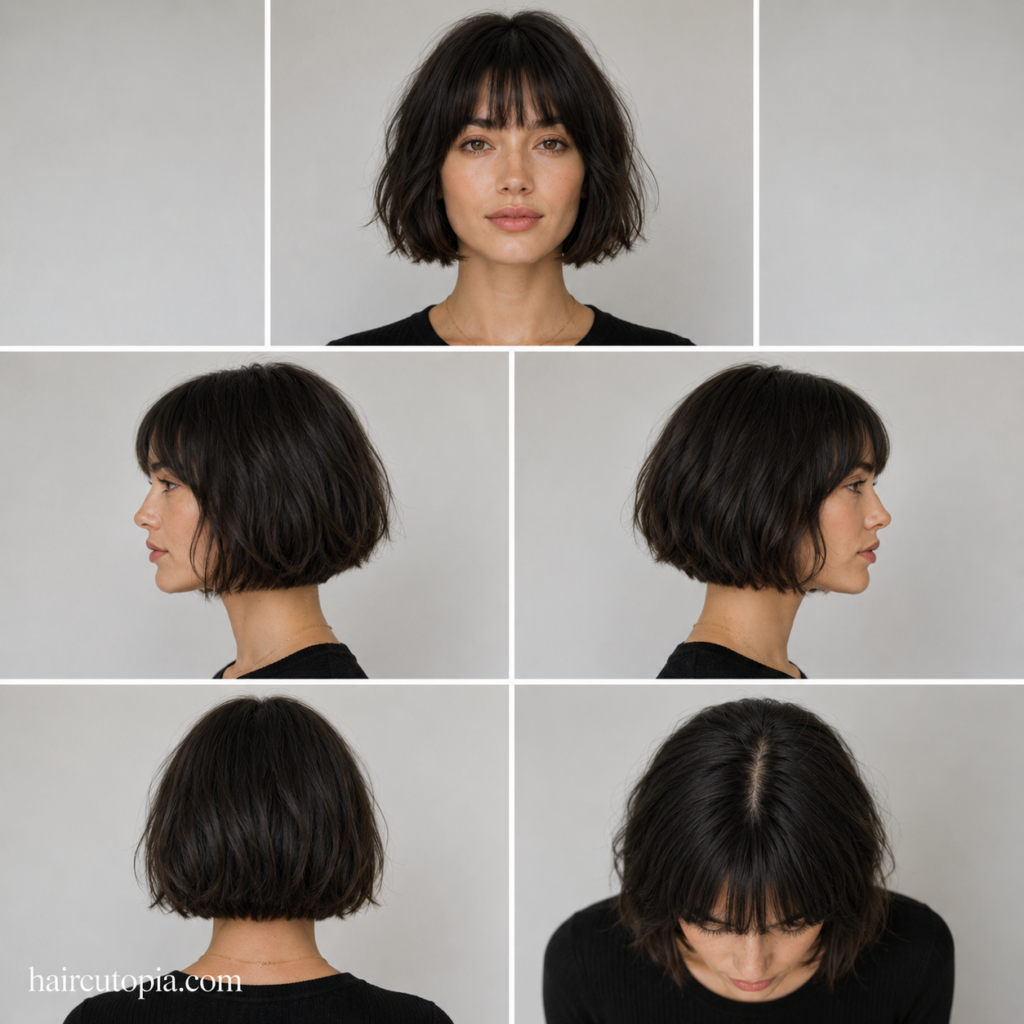
The French bob is more flexible than its classic definition might suggest.
Small changes in length, fringe, and texture create very different results.
Classic French Bob
The classic French bob is short, compact, and typically paired with bangs.
The perimeter usually falls around the jaw or chin.
The ends may be relatively blunt, creating a clear shape around the face.
Traditional versions often look best with a little natural movement rather than an overly styled finish.
Short French Bob
A short French bob takes the compact proportions of a short bob even higher, with the perimeter potentially sitting around the lips or upper jaw.
This creates a dramatic, face-focused silhouette.
Because the length is so compact, small differences matter.
Even an extra inch can noticeably change how the haircut frames the cheeks and jaw.
Short French bobs also expose more of the neck.
Chin-Length French Bob
Chin length is one of the most versatile versions.
It maintains the short character of the French bob while providing enough length for waves, curls, and different partings.
The perimeter can be:
- Blunt
- Soft
- Textured
- Slightly graduated
Chin-length French bobs work particularly well if you want a recognizable short bob without going extremely short.
Jaw-Length French Bob
A jaw-length French bob places the perimeter directly around the lower face.
This can create a strong silhouette when worn straight.
Waves or texture soften the effect.
The exact position of the ends becomes important because the haircut naturally draws attention toward the jaw.
Lip-Length French Bob
A lip-length French bob is a shorter, bolder variation.
The ends sit around the mouth or slightly lower.
This creates a compact shape that places substantial focus on the face.
Because the haircut is short, regular maintenance becomes more important if you want to preserve the exact length.
Long French Bob
A longer French bob extends below the chin while keeping the general compact shape and styling associated with the style.
It can be a good entry point if you’re interested in a French bob but hesitant to cut directly to the jaw.
The longer length also provides:
- More styling flexibility
- Easier grow-out
- More room for waves
- Slightly easier tying back
Keep the overall silhouette relatively short if you want it to retain the French bob character.
Blunt French Bob
A blunt French bob combines the compact proportions of the style with the strong, clean perimeter of a blunt cut.
The ends appear full and relatively uniform rather than heavily layered.
This can create a particularly striking result on straight hair.
A blunt French bob may also work well for fine hair because keeping more density through the bottom can make the ends appear fuller.
The haircut doesn’t have to be perfectly sleek.
Loose waves over a blunt perimeter create an interesting combination of structure and movement.
Textured French Bob
A textured bob approach softens the classic French bob shape by creating more separation and movement through the ends and interior.
Instead of maintaining one completely solid edge, subtle cutting techniques create separation and movement.
Texture may come from:
- Light layering
- Point cutting
- Piecey ends
- Natural waves
- Tousled styling
This version feels less geometric than a blunt French bob.
It can be especially appealing if you want a relaxed, slightly undone finish.
Layered French Bob
Layers can create more movement within a French bob.
Because the haircut is already short, the placement needs to be intentional.
Very short layers can quickly change the silhouette.
Subtle layers can:
- Remove bulk
- Enhance waves
- Create movement
- Add crown volume
- Soften the perimeter
Fine or low-density hair may need fewer layers to preserve fullness.
Thick or naturally textured hair can often support more internal movement.
Tousled French Bob
The tousled French bob focuses on effortless-looking texture.
Loose bends and irregular movement prevent the haircut from appearing too polished.
The goal isn’t perfect curls.
A little variation makes the style feel more natural.
Tousled French bobs pair especially well with:
- Wispy bangs
- Curtain bangs
- Piecey ends
- Natural waves
- Slightly off-center parts
This is one of the easiest ways to give a classic short bob a more casual personality.
Wavy French Bob
Waves naturally complement the French bob’s compact shape.
The movement softens the perimeter and creates dimension around the face.
If your hair is naturally wavy, removing length may make your pattern more noticeable because there’s less weight stretching the hair downward.
That can be a benefit, but it also affects the finished length.
A bob cut to the chin while wet may sit higher once the waves form.
Curly French Bob
Curly hair can create a beautiful variation of the French bob.
Instead of forming a smooth horizontal perimeter, the curls create a softer, fuller silhouette.
A curly French bob may include:
- Curly bangs
- Light layering
- A rounded shape
- Chin-length curls
- Jaw-length curls
Shrinkage is one of the most important considerations.
The finished dry length matters more than how long the hair appears when stretched.
French Bob With Bangs
Bangs are closely associated with the French bob, but there’s no single fringe style you need to choose.
Possible options include:
- Blunt bangs
- Wispy bangs
- Curtain bangs
- Micro bangs
- Choppy bangs
- Side-swept bangs
- Curly bangs
The fringe can completely change the haircut.
Blunt bangs reinforce the graphic shape.
Wispy bangs make it softer.
Curtain bangs create more movement and openness around the center of the face.
French Bob With Blunt Bangs
Blunt bangs create one of the strongest versions of the French bob.
Both the fringe and main perimeter have clear lines.
This combination works particularly well if you like:
- Structured haircuts
- Sleek styling
- Defined shapes
- Full fringe
The bangs don’t necessarily need to be extremely heavy.
A moderately dense blunt fringe can provide structure while remaining easy to move.
French Bob With Wispy Bangs
Wispy bangs provide a softer alternative.
Instead of forming one solid line across the forehead, the fringe separates into lighter sections.
This creates contrast with a stronger bob perimeter.
Wispy bangs can also blend naturally with tousled or wavy styling.
They’re a good choice if you want fringe without making it the heaviest element of the haircut.
French Bob With Curtain Bangs
Curtain bangs open around the center and gradually become longer toward the sides.
On a French bob, the outer fringe can connect directly with the main perimeter.
This creates continuous movement around the face.
Shorter curtain bangs make the fringe more noticeable.
Longer versions can almost resemble face-framing pieces.
French Bob With Micro Bangs
Micro bangs sit noticeably above the eyebrows.
Combined with a short French bob, they create a bold, graphic haircut.
This is a higher-commitment fringe because the short length is immediately noticeable.
It can work particularly well with:
- Straight bobs
- Textured bobs
- Wavy hair
- Strong perimeters
If you’re uncertain about very short bangs, starting longer gives you more flexibility.
French Bob Without Bangs
Bangs aren’t required.
A French bob without bangs places more emphasis on the part and front sections.
You can wear it with:
- A center part
- An off-center part
- A deep side part
- Front pieces tucked behind the ears
Without fringe, the haircut may feel cleaner and more minimal.
It can also be easier to maintain because there’s no short bang section requiring frequent trimming.
French Bob With a Middle Part
A middle part creates symmetry and keeps the forehead open.
It works particularly well with:
- Sleek bobs
- Wavy French bobs
- Curtain bangs
- Chin-length styles
The front sections fall evenly around both sides of the face.
If the haircut has a strong perimeter, a center part can make the overall shape feel especially balanced.
French Bob With a Side Part
A side part creates more asymmetry.
It can also add natural lift around the crown because more hair is directed toward one side.
Side parts work well with:
- Wavy texture
- Side-swept fringe
- Tousled styling
- Fine hair needing additional lift
Changing your part is one of the easiest ways to make the same French bob feel different without cutting anything.
French Bob for Fine Hair
A French bob can be an excellent option for fine hair.
Shortening the overall length reduces weight, while a stronger perimeter can make the ends appear fuller.
Fine hair often works well with:
- Blunt or semi-blunt ends
- Minimal layering
- Lightweight fringe
- Subtle texture
- Lightweight styling products
Be cautious with excessive thinning or heavy layering.
If too much density is removed, the perimeter may lose the fullness that makes a short bob so effective.
French Bob for Thin or Low-Density Hair
Fine hair refers to strand thickness, while low density refers to how much hair you have overall.
If your density is lower, maintaining fullness through the ends becomes especially important.
Consider:
- A relatively strong perimeter
- Limited internal layering
- Wispy rather than extremely heavy bangs
- Chin or jaw length
- Lightweight volumizing products
Cutting away thin, tapered ends can sometimes make the remaining hair look noticeably fuller.
French Bob for Thick Hair
Thick hair creates a naturally substantial French bob.
The challenge is often managing bulk.
A completely one-length short bob can become very wide through the bottom depending on your texture.
Subtle internal layering can help redistribute weight without destroying the perimeter.
Your stylist may use:
- Internal layers
- Graduation
- Light texturizing
- Strategic weight removal
The goal is to create movement while preserving the compact French bob silhouette.
French Bob for Straight Hair
Straight hair makes the shape of a French bob especially visible.
A blunt perimeter and fringe can look extremely clean.
You can style straight French bobs:
- Sleek
- Slightly curved under
- Piecey
- Tucked behind the ears
- With flipped ends
Straight hair also shows small differences in the perimeter clearly, so precision matters if you prefer a polished finish.
French Bob for Wavy Hair
Wavy hair gives the French bob a softer appearance.
The perimeter becomes less rigid, and the natural movement creates volume around the face.
You may not need extensive layering.
Sometimes simply removing length allows the wave pattern to become more visible.
If your waves vary throughout your head, the bob may look intentionally irregular rather than perfectly symmetrical.
That’s part of the appeal.
French Bob for Curly Hair
Curly hair brings natural volume and movement to the French bob.
The cut should account for:
- Curl pattern
- Shrinkage
- Density
- Desired volume
- Bang length
A curly French bob can be worn with or without fringe.
Curly bangs can make the haircut feel particularly cohesive because the same texture continues across the forehead.
Avoid choosing the final length based only on stretched or wet hair.
French Bob for Coily Hair
Coily hair can create a compact, sculptural interpretation of the French bob.
The shape may be rounded or slightly wider through the sides depending on layering.
Shrinkage needs careful consideration.
The finished dry perimeter may sit considerably higher than the stretched length.
Rather than trying to reproduce the straight lines of a sleek French bob, focus on the overall short silhouette and how the coils frame the face.
French Bobs for Different Face Shapes
There’s no face shape that automatically rules out a French bob.
Length, fringe, volume, and texture matter more than rigid rules.
French Bob for Oval Faces
Oval faces can experiment with almost any version.
Short lip-length styles create a dramatic effect, while chin-length bobs provide a more classic proportion.
French Bob for Round Faces
A chin-length or slightly longer French bob can create a clear frame around the face.
If you prefer more vertical movement, choose a slightly longer front or an open fringe.
If you like a fuller, more compact silhouette, go shorter.
French Bob for Square Faces
A blunt French bob can intentionally complement a defined jaw.
For a softer effect, add waves, texture, or wispy fringe.
Neither approach is inherently better.
It depends on whether you want to emphasize structure or contrast with it.
French Bob for Heart-Shaped Faces
Jaw- and chin-length bobs can create fullness around the lower portion of the face.
Fringe can add another element around the forehead.
Wispy or curtain bangs provide a softer transition than a heavy blunt fringe.
French Bob for Long Faces
Short bobs create horizontal structure around the face.
Bangs can further change the proportions by visually breaking up the forehead.
A chin-length bob with fringe is one of the more classic combinations.
French Bob vs. Classic Bob
The French bob is generally shorter and more face-focused than a classic bob.
A classic bob can extend anywhere from around the jaw toward the shoulders.
French bobs commonly emphasize:
- Shorter lengths
- Exposed neck
- Fringe
- Compact shape
- Relaxed texture
There is plenty of overlap.
A chin-length classic bob with bangs could easily be described as a French bob depending on its styling and overall shape.
French Bob vs. Blunt Bob
A blunt bob describes the perimeter.
A French bob describes a broader hairstyle.
That means a French bob can also be blunt.
A blunt French bob combines:
- Short length
- Strong perimeter
- Minimal layering
- Optional fringe
A French bob can also be textured or layered, so it doesn’t need a completely blunt edge.
French Bob vs. Textured Bob
A textured bob can be almost any bob length and emphasizes movement and separation.
A French bob generally emphasizes shorter length and a compact, face-framing shape.
A textured French bob combines both.
It keeps the short proportions while introducing piecey ends, layers, waves, or tousled styling.
French Bob vs. Italian Bob
French and Italian bobs share some similarities, but their typical proportions are different.
The French bob is generally shorter and often paired with fringe.
An Italian bob usually has a fuller, slightly longer shape, often sitting around the chin or lower with more weight and volume through the ends.
French bobs tend to feel:
- Shorter
- Lighter
- More compact
- More fringe-focused
Italian bobs tend to feel:
- Fuller
- Heavier
- Longer
- More voluminous
Modern interpretations can overlap, so the actual length and shape matter more than the label.
French Bob vs. Bixie
A bixie combines characteristics of a bob and pixie and generally includes more layering and shorter sections than a French bob.
A French bob maintains a clearer perimeter around the head.
A bixie usually has:
- Shorter crown layers
- More tapering
- More visible layering
- A less uniform perimeter
If you want a recognizable bob shape, the French bob is usually the more structured choice.
French Bob vs. Lob
The difference between a French bob and a lob is primarily length. A French bob usually ends around the jaw or chin, while a lob falls closer to the shoulders or collarbone.
The lob provides:
- More tying-back options
- More weight
- More room for long layers
- A less dramatic transition from long hair
A French bob creates a more obvious short-hair transformation.
How to Style a French Bob
One of the strengths of a French bob is that it doesn’t need one specific finish.
Sleek and Straight
Smooth styling highlights the perimeter.
Use heat protectant before hot tools and keep the ends polished.
Softly Tousled
Add loose, irregular bends through the lengths.
Avoid making every section identical.
The variation creates a more relaxed finish.
Natural Waves
If your hair already has movement, let the cut do most of the work.
Use lightweight products that encourage your natural pattern without making it stiff.
Curved Under
A round brush or styling tool can direct the ends inward.
This creates a classic, polished bob shape.
Flipped Ends
Turning the ends outward creates a playful alternative.
You can flip the entire perimeter or only selected sections.
Tucked Behind the Ears
A simple ear tuck exposes more of the face and can make a French bob look instantly cleaner.
It works particularly well with a center part or bangs.
How to Get the Effortless French Bob Look
“Effortless” styling usually requires some intention.
The trick is avoiding a finish that looks overly uniform.
Try this approach:
- Apply products appropriate for your natural texture.
- Dry the hair without flattening all of its movement.
- Add a few loose bends where needed.
- Leave some sections straighter than others.
- Separate the ends gently with your fingers.
- Adjust the fringe rather than making it perfectly rigid.
- Finish with a small amount of lightweight texture product if needed.
The goal is controlled imperfection.
You want the haircut to retain its shape while still moving naturally.
What Products Work Well for a French Bob?
The best products depend on your texture.
Useful options may include:
- Heat protectant
- Lightweight smoothing cream
- Volumizing mousse
- Texture spray
- Curl cream
- Anti-frizz serum
- Flexible-hold hairspray
- Lightweight styling paste
Fine hair usually needs lighter formulas.
Thick, curly, or coarse hair may benefit from additional moisture and control.
If you’re creating piecey ends, start with very little product.
Short hair can become weighed down quickly.
Is a French Bob Low Maintenance?
The styling can be relatively simple.
The haircut itself requires more maintenance if you want to keep it short.
A French bob grows out of its defining length faster than a long haircut.
Bangs may need even more frequent attention.
Maintenance depends on:
- Overall length
- Fringe style
- Hair growth rate
- Perimeter precision
- Natural texture
A tousled French bob is generally more forgiving than a perfectly sleek, blunt version.
How Often Should a French Bob Be Trimmed?
Many French bobs benefit from reshaping approximately every 6–8 weeks.
Very short versions may need more frequent trims if you want to preserve the exact length.
Longer or softer versions may go 8–10 weeks or more.
Bangs may need attention between full haircuts.
Rather than following a strict schedule, watch the shape.
When the bob begins sitting too low or the fringe becomes difficult to style, it’s probably time for a trim.
How to Ask Your Hairstylist for a French Bob
“French bob” can mean different things to different people.
Reference photos are extremely helpful.
Discuss:
- Where you want the perimeter to fall.
- Whether you want bangs.
- What type of bangs you prefer.
- Whether you want blunt or textured ends.
- How much layering you want.
- Whether you wear your hair straight or naturally textured.
- How much shrinkage your hair has.
- How often you’re willing to maintain the cut.
Be precise about length.
Instead of simply saying “chin length,” physically show your stylist where you want the dry hair to end.
An inch can make a substantial difference on a short bob.
Growing Out a French Bob
A French bob has a relatively straightforward grow-out.
As it gets longer, it gradually becomes:
- A classic bob
- A neck-length bob
- A long bob
- A lob
The main challenge may be the bangs.
You can gradually transition short fringe into:
- Wispy bangs
- Curtain bangs
- Side-swept bangs
- Face-framing layers
Regular small trims can keep the perimeter healthy while allowing the overall length to increase.
If your French bob contains short layers, those may take longer to blend into a one-length shape.
Who Should Consider a French Bob?
A French bob may be a good option if you:
- Want a noticeable short haircut
- Like chin- or jaw-length hair
- Want to expose more of the neck
- Enjoy bangs or fringe
- Prefer a simple silhouette
- Like natural or tousled texture
- Want less overall hair length
- Like classic styles with modern variations
- Want a bob that frames the face closely
You don’t need a particular face shape or hair texture.
The key is adapting the length and internal structure to the way your hair naturally behaves.
Common French Bob Mistakes to Avoid
A short haircut leaves less room for error, so planning matters.
Cutting Too Short Without Considering Shrinkage
Waves, curls, and coils can spring considerably higher when dry.
Always consider the finished natural length.
Assuming You Need Bangs
Fringe is common, but it’s optional.
A short bob without bangs can still have the compact character associated with the style.
Adding Too Many Layers to Fine Hair
Excessive layering can make the perimeter look thin.
Keep enough density through the ends.
Leaving Too Much Weight in Thick Hair
Very dense hair may need subtle internal adjustment to avoid becoming overly wide.
Choosing Bangs Without Considering Maintenance
Short fringe changes quickly as it grows.
Think about how often you’re willing to trim or style it.
Using Too Much Product
Short hair can become heavy or greasy quickly.
Start with small amounts.
Choosing Length From a Straightened Reference
If you normally wear your hair wavy or curly, use reference photos with a similar texture.
Expecting Effortless to Mean No Styling
Some French bobs air-dry beautifully.
Others need a few strategic adjustments to create that intentionally undone finish.
Frequently Asked Questions About French Bob Haircuts
What is a French bob haircut?
A French bob is a short bob that usually falls around the jaw or chin and is often paired with bangs or fringe.
How short is a French bob?
Most French bobs sit somewhere between the lips and chin, although slightly longer interpretations are common.
Does a French bob have to have bangs?
No. Bangs are strongly associated with the style, but French bobs can be worn without fringe.
Is a French bob good for fine hair?
Yes. A strong perimeter and shorter length can help fine hair appear fuller, particularly when excessive layering is avoided.
Is a French bob good for thick hair?
Yes. Thick hair may need subtle layering or internal weight removal to prevent the short shape from becoming too bulky.
Can straight hair have a French bob?
Absolutely. Straight hair highlights the compact shape and works particularly well with blunt or sleek versions.
Can wavy hair have a French bob?
Yes. Natural waves create a softer, more relaxed interpretation of the haircut.
Can curly hair have a French bob?
Yes. Curl pattern and shrinkage should be considered when choosing the final length.
Can coily hair have a French bob?
Yes. The compact bob silhouette can be adapted to coils while preserving their natural volume and movement.
What’s the difference between a French bob and a regular bob?
A French bob is generally shorter, often sitting around the jaw or chin, and is frequently paired with fringe and a relaxed finish.
What’s the difference between a French bob and an Italian bob?
French bobs are typically shorter and more compact. Italian bobs are generally longer, fuller, and heavier through the ends.
Can a French bob be layered?
Yes. Subtle layering can create movement, reduce bulk, or enhance natural texture.
Can a French bob be blunt?
Yes. A strong blunt perimeter is one of the classic ways to wear a French bob.
Are French bobs high maintenance?
The styling can be simple, but maintaining a short perimeter and fringe usually requires regular trims.
How often should a French bob be trimmed?
Around every 6–8 weeks works for many versions, although longer and more relaxed styles may go longer between trims.
Final Thoughts on French Bob Haircuts
The French bob has a simple foundation: keep the hair short, frame the face, and let the shape do most of the work.
Everything else can be customized.
You can choose a sharp blunt perimeter or soften the ends with texture. You can add full bangs, wispy fringe, curtain bangs, or skip bangs entirely. You can straighten the hair until the shape looks almost geometric or let waves and curls make the perimeter feel loose and natural.
Length is where the biggest decision happens.
A lip- or jaw-length French bob creates a bold transformation and puts the focus firmly on the face. Chin length gives you a little more flexibility. Going slightly longer can make the haircut easier to transition into if you’re coming from medium or long hair.
Your natural texture should guide the final shape too.
Fine hair may benefit from keeping the perimeter full. Thick hair can use subtle internal weight removal. Waves, curls, and coils need enough length to account for how much they spring upward when dry.
And if you like the slightly undone French bob look, don’t worry about making every strand perfect.
The haircut already provides the structure.
A little movement, separation, and natural texture can provide the rest.
Related Posts
 Lob Haircuts for Square Faces: 25 Flattering Styles to Soften Strong Features
 Medium Bixie Haircuts: 27 Stylish Ideas That Perfectly Balance a Pixie and Bob
 Face-Framing Layers Haircuts for Straight Hair: 25 Sleek Styles That Add Movement and Dimension
 Wolf Cut Haircuts for Diamond Faces: 25 Flattering Styles That Highlight Your Best Features