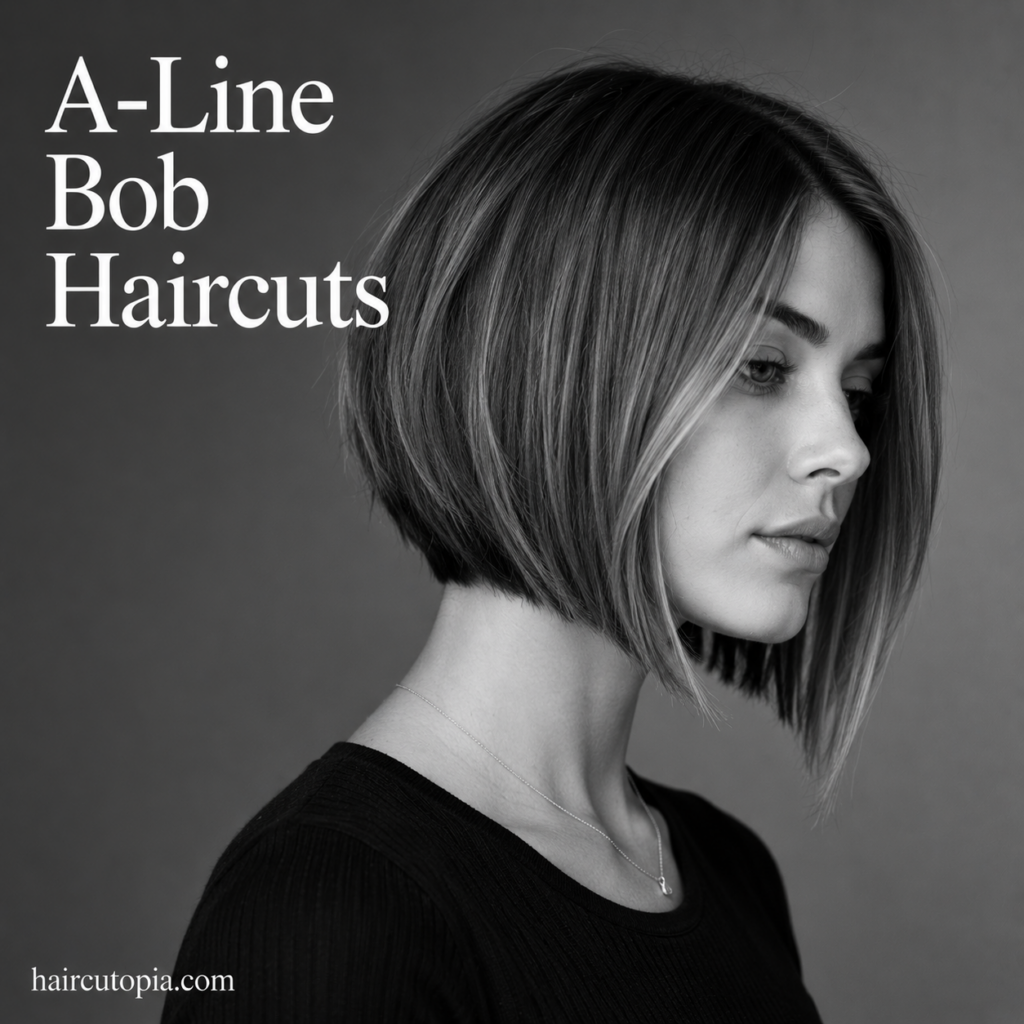
An A-line bob takes the familiar bob shape and gives it a little more direction.
Instead of keeping the front and back at roughly the same length, the haircut gradually becomes longer toward the face. That angle can be so subtle you barely notice it, or dramatic enough that the difference between the back and front becomes the main feature of the cut.
That’s what makes the A-line bob surprisingly versatile.
You can wear it short and sharp, soft and slightly tousled, sleek and polished, or long enough to brush the shoulders. The back can stay relatively simple or include graduation and stacking for extra volume. Bangs, face-framing pieces, waves, curls, and different partings can change the look even further.
The key is choosing the right angle.
A subtle A-line bob can feel almost like a classic bob with a little extra movement around the front. A steeply angled version creates a much stronger silhouette and usually requires more regular maintenance to preserve its shape.
If you’re considering an A-line bob, here’s what to know about the different lengths, angles, textures, styling options, and ways to customize the haircut.
What Is an A-Line Bob Haircut?
An A-line bob is a variation of the classic bob haircut that’s shorter in the back and gradually becomes longer toward the front.
Viewed from the side, the perimeter slopes downward toward the face.
That angled outline creates the characteristic A-line shape.
Depending on the haircut, the difference between the back and front may be:
- Very subtle
- Moderately angled
- Dramatically angled
- Graduated through the back
- Stacked for additional volume
Not every A-line bob has a stacked back.
That’s an important distinction.
The defining feature is the length progression from shorter in the back to longer in the front.
Why Is It Called an A-Line Bob?
The name comes from the overall silhouette.
The haircut widens or extends toward the front, creating an angled shape associated with the lines of the letter A.
In practice, the exact geometry varies.
Some A-line bobs have a nearly horizontal perimeter with only slightly longer front sections.
Others have a very visible diagonal line running from the nape toward the chin or collarbone.
The term describes the general shape rather than one exact cutting formula.
What Does an A-Line Bob Look Like?
From the front, an A-line bob may look similar to several other bob styles.
The angle becomes much easier to see from the side.
The back sits shorter, while the perimeter gradually travels downward toward longer front pieces.
From behind, the haircut may have:
- A straight baseline
- A softly rounded shape
- Graduation
- Stacking
- Subtle layers
From the side, you’ll see the defining slope.
The front pieces might finish around the jaw, chin, collarbone, or shoulders depending on the overall length.
Why Choose an A-Line Bob?
Among shorter women’s haircuts, an A-line bob offers some of the benefits of short hair while preserving additional length around the face.
That’s one reason it has remained such a recognizable bob variation.
You might consider an A-line bob if you:
- Want to go shorter without losing all your front length
- Like structured haircuts
- Want movement around the face
- Prefer a bob with a visible shape
- Want more volume through the back
- Like longer front sections
- Want a cut that looks polished when straight
- Prefer an angled perimeter
- Want something more distinctive than a one-length bob
The amount of commitment depends largely on the angle.
A subtle A-line shape can grow out relatively easily.
A dramatic angle needs more maintenance to keep the difference between the back and front looking intentional.
Popular Types of A-Line Bob Haircuts
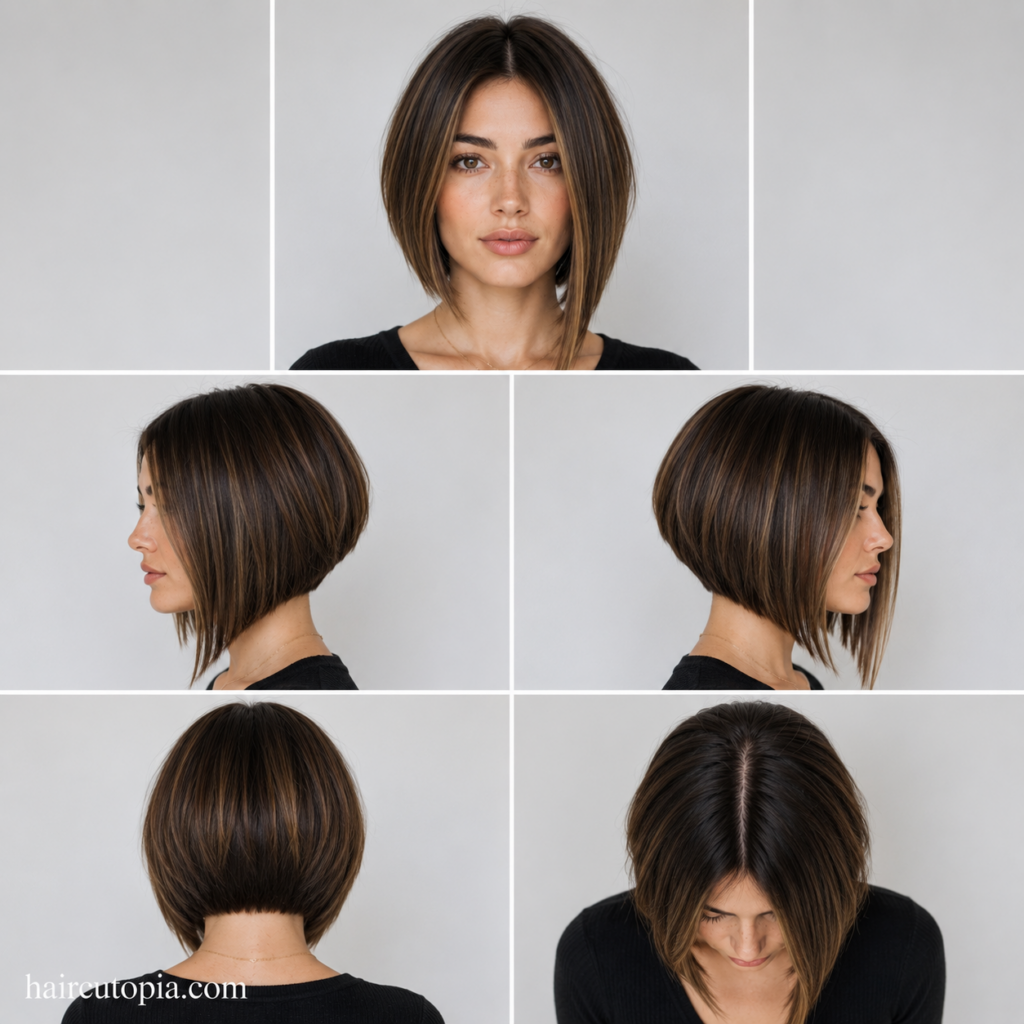
A-line bobs can look dramatically different depending on length, angle, layering, and graduation.
Classic A-Line Bob
A classic A-line bob is shorter in the back and gradually becomes longer toward the front.
The angle is noticeable without being extreme.
The back may have light graduation but doesn’t necessarily need obvious stacking.
This version works well if you want the recognizable A-line shape without making the haircut overly dramatic.
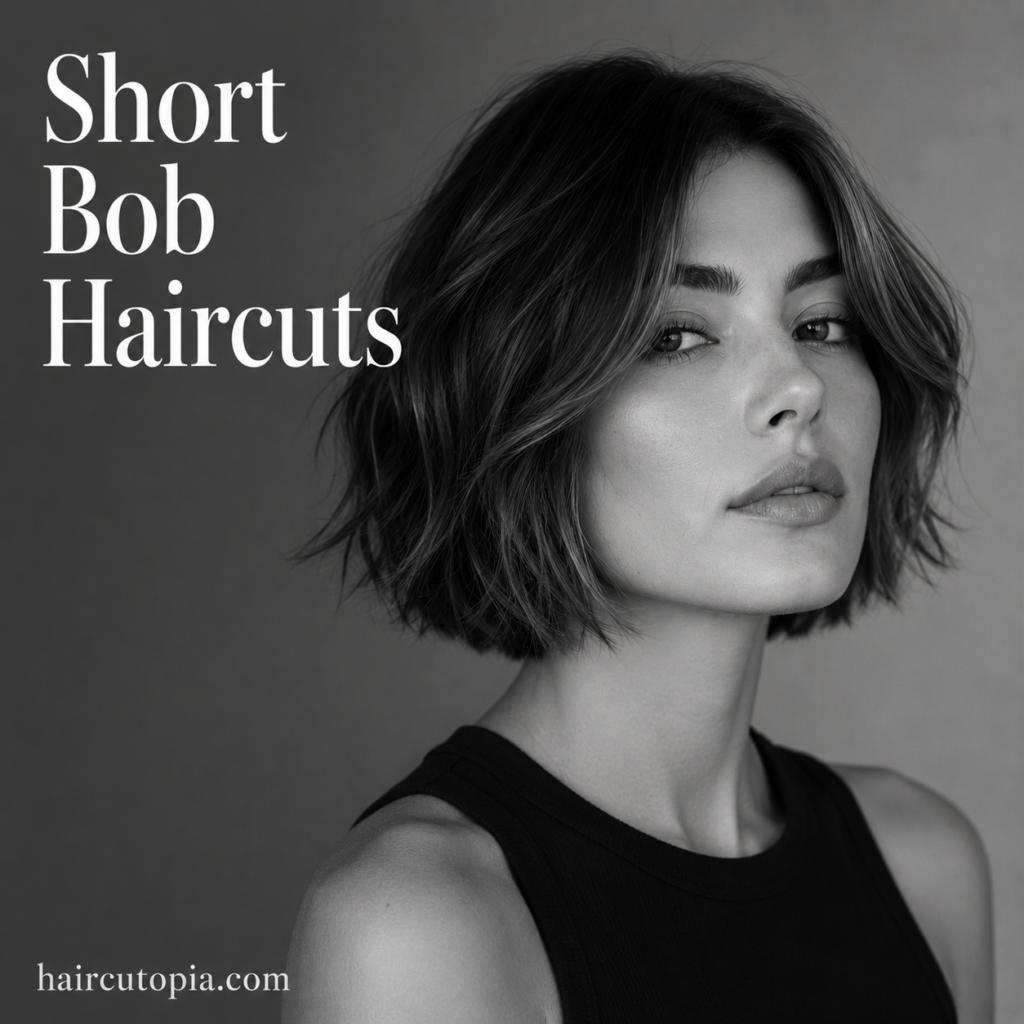
Short A-Line Bob
A short A-line bob applies the angled silhouette to the compact proportions of a short bob, with the back potentially sitting around the nape while the front reaches the jaw or chin.
The shorter back makes the angle easier to see.
This style exposes more of the neck and creates a compact silhouette.
Depending on the amount of graduation, it can look sleek or rounded.
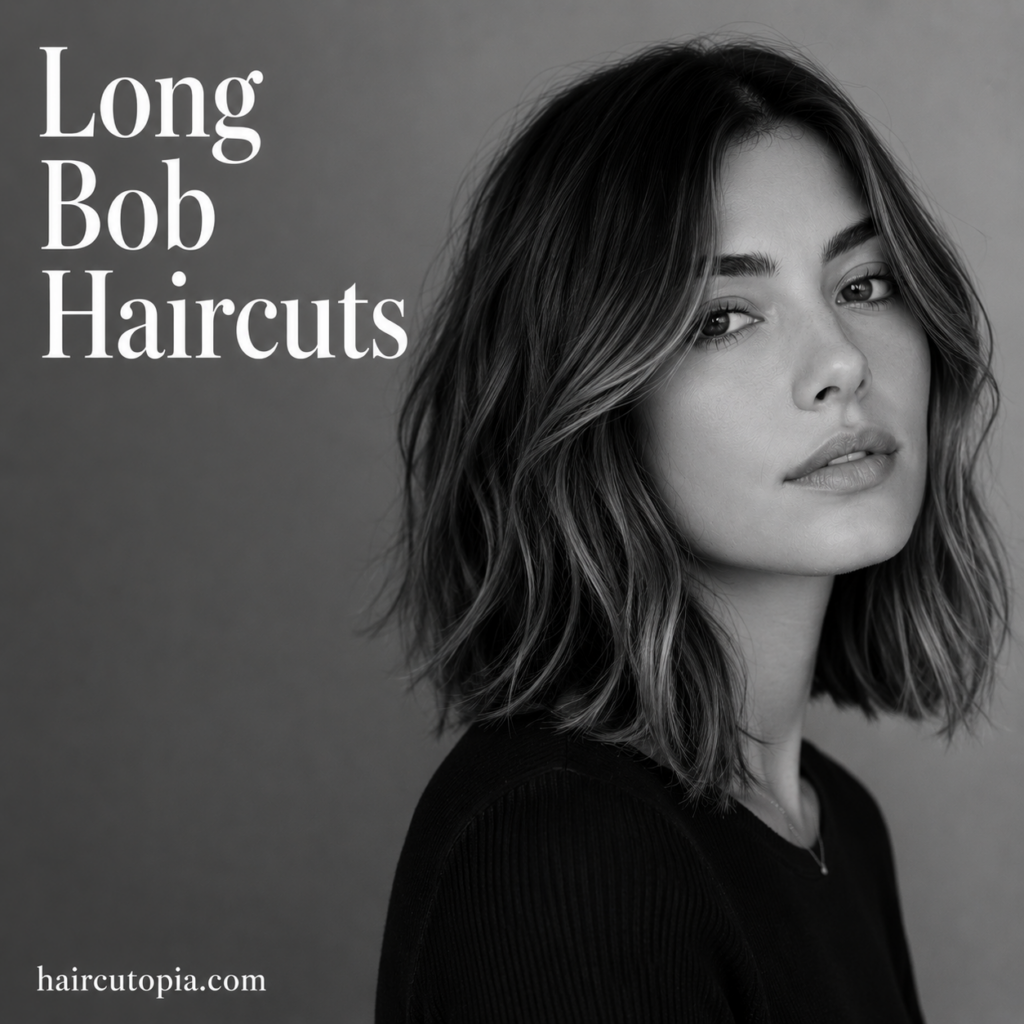
Long A-Line Bob
A long A-line bob keeps more length throughout the haircut.
The back might sit around the shoulders while the front approaches the collarbone or slightly lower.
The angle is generally softer because there’s more hair available to create a gradual transition.
A long A-line bob is a good option if you like angled haircuts but aren’t ready for short hair.
Subtle A-Line Bob
A subtle A-line bob has only a small difference between the back and front.
The haircut may appear almost one length from certain angles.
From the side, however, the front pieces sit slightly lower.
This is one of the easiest versions to grow out because the perimeter doesn’t need to change dramatically as the hair gains length.
Dramatic A-Line Bob
A dramatic A-line bob creates a much steeper slope.
The back may be significantly shorter than the front.
This makes the side profile a major feature of the haircut.
Dramatic angles work particularly well when you want:
- A strong silhouette
- Longer front pieces
- A short back
- A more graphic haircut
- Noticeable contrast between lengths
Because the shape is precise, regular trims become more important.
Chin-Length A-Line Bob
A chin-length A-line bob usually has front pieces ending around the chin while the back sits somewhat higher.
This creates a classic short-bob silhouette.
The exact placement matters.
A small difference between the back and front creates a soft angle.
A shorter nape creates a stronger diagonal line.
Chin-length A-line bobs can be worn straight, softly waved, or naturally textured.
Jaw-Length A-Line Bob
A jaw-length A-line bob creates an even shorter overall shape.
The front pieces may finish around the jaw while the back sits higher toward the nape.
This version can feel sharp and modern when worn sleek.
Adding texture softens the outline considerably.
Because there’s less length, the back and neckline become especially important parts of the haircut.
Neck-Length A-Line Bob
A neck-length A-line bob provides a little more length through the back while maintaining the angled perimeter.
The front may extend toward the chin or lower.
This creates a balanced shape that isn’t extremely short but still clearly reads as a bob.
It’s also long enough to experiment with waves and softer styling.
Shoulder-Length A-Line Bob
A shoulder-length A-line bob sits closer to long-bob territory.
The back may approach the shoulders while the front falls slightly below them.
The angle tends to feel more relaxed.
This length offers greater styling flexibility and may still be long enough for a small ponytail or half-up style.
One consideration is where the back ends meet the shoulders.
Hair sitting directly on the shoulders may naturally flip outward.
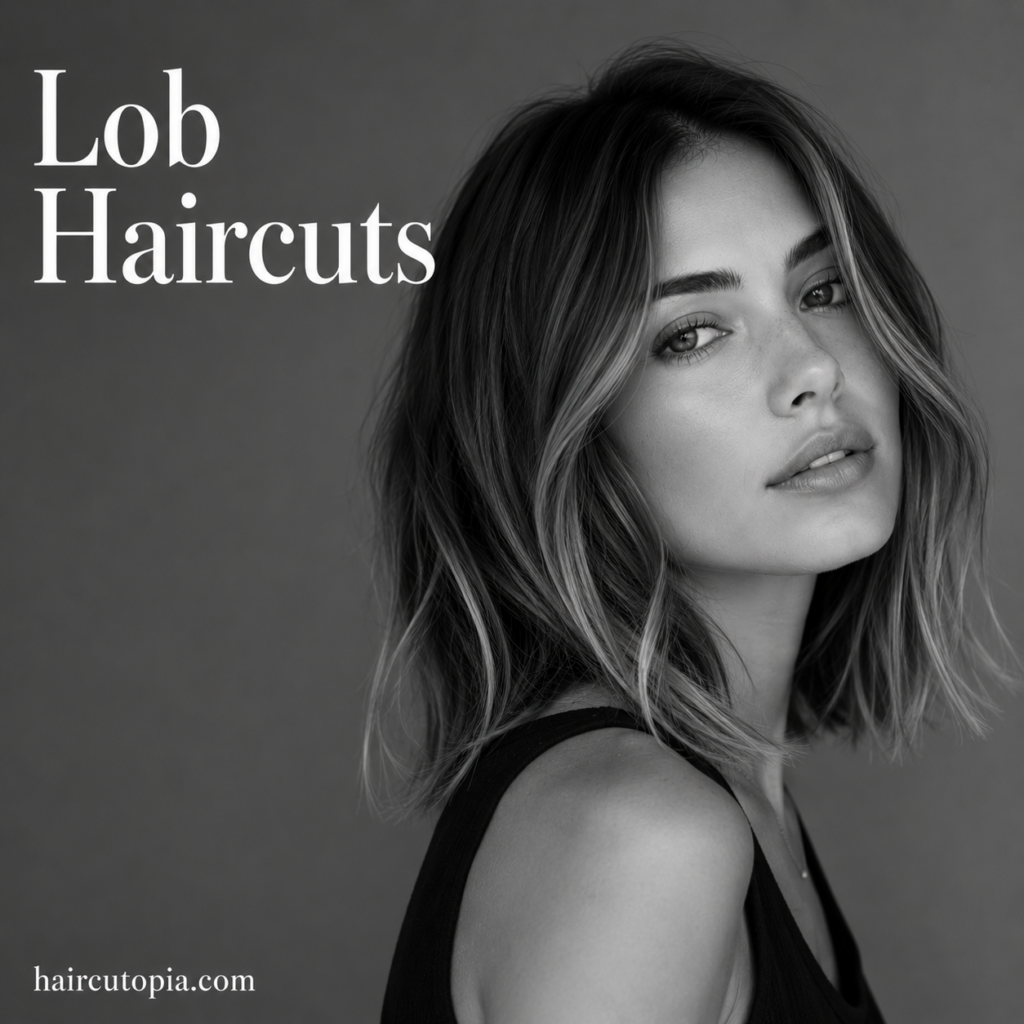
A-Line Lob
An A-line lob combines the angled silhouette with the longer proportions of a lob, usually placing the back around the shoulders and the front closer to the collarbone or slightly below.
This creates a subtle elongated effect.
An A-line lob can be especially useful if you want:
- An angled haircut without going short
- Enough length to tie back
- A softer grow-out
- More styling options
- Longer face-framing sections
The angle can still be dramatic, but many A-line lobs use a relatively gentle slope.
A-Line Bob With No Layers
An A-line bob doesn’t require layers.
A minimally layered version keeps the perimeter strong and allows the angle itself to create the shape.
This works particularly well if you want:
- Fuller-looking ends
- A sleek finish
- A strong baseline
- Minimal internal movement
Fine or lower-density hair may benefit from keeping more weight around the perimeter.
The back can still be shorter than the front without adding substantial layering.
Layered A-Line Bob
Adding layers creates more movement within the angled shape while allowing the shorter-back, longer-front perimeter to remain the defining feature.
The interior can contain additional lengths without losing the A-line direction of the exterior shape.
Layers can help:
- Reduce bulk
- Add movement
- Create crown volume
- Enhance natural texture
- Soften the perimeter
The amount of layering should depend on your density and desired finish.
You don’t need heavy layers to make an A-line bob move.
Stacked A-Line Bob
A stacked A-line bob adds shorter graduated layers through the back.
These layers build weight and volume around the crown or occipital area while the front remains longer.
This creates a more rounded back profile.
The stack may be subtle or pronounced.
A heavily stacked version creates a stronger difference between the back and front and often requires more frequent maintenance.
A lightly stacked A-line bob can provide lift without dramatically changing the silhouette.
Graduated A-Line Bob
Graduation creates a gradual buildup of weight through the back.
The technique is closely associated with many A-line and stacked bob styles.
A graduated A-line bob usually appears:
- Shorter at the nape
- Fuller higher through the back
- Longer toward the front
The result can be sleek and sculpted or softer depending on the amount of graduation and styling.
A-Line Bob With a Blunt Perimeter
An A-line bob can maintain the strong, clean perimeter associated with a blunt cut while still becoming progressively longer toward the face.
Instead of adding obvious texture through the ends, the perimeter remains clean and defined.
The difference from a traditional blunt bob is the angle.
A standard blunt bob may remain relatively level from back to front.
An A-line blunt bob becomes progressively longer toward the face.
This combination works especially well on straight hair because the diagonal line is easy to see.
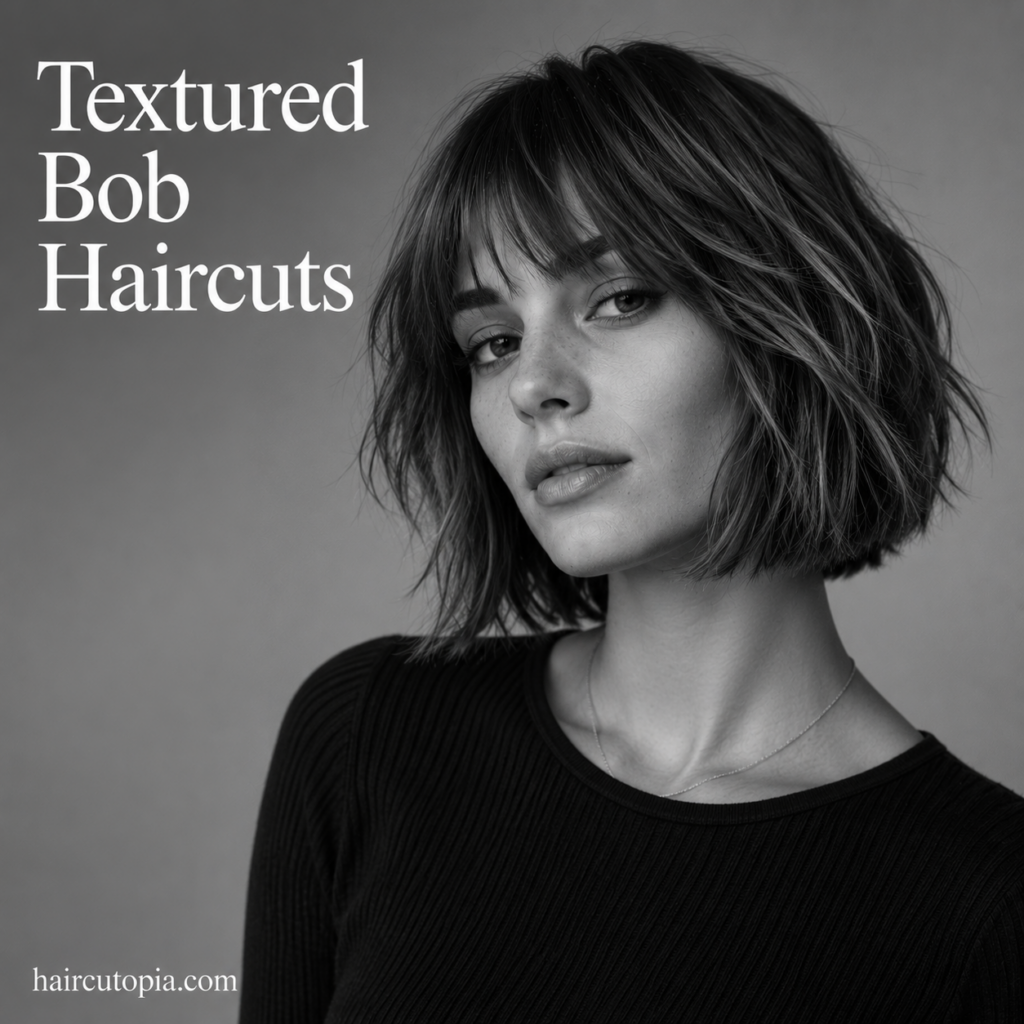
Textured A-Line Bob
A textured bob approach can soften the structured geometry of an A-line haircut by introducing more movement through the ends and interior.
Instead of emphasizing a perfectly smooth diagonal perimeter, the hair has movement through the ends and interior.
Texture can come from:
- Subtle layers
- Point cutting
- Natural waves
- Loose curls
- Piecey styling
A textured A-line bob is a good choice if you like the angled silhouette but don’t want the haircut to look overly precise.
Choppy A-Line Bob
A choppy A-line bob makes the texture more noticeable.
Shorter sections and piecey ends create separation throughout the haircut.
The A-line perimeter remains visible underneath.
This creates an interesting contrast between a structured overall silhouette and a less polished surface.
Choppy versions pair particularly well with tousled styling.
A-Line Bob With Face-Framing Layers
The front of an A-line bob is already longer, so face-framing layers need to be planned carefully to avoid weakening the elongated front perimeter.
Adding shorter front pieces can soften the long perimeter around the face.
Depending on the bob length, face framing might begin around the:
- Cheekbones
- Jaw
- Chin
Longer face-framing layers usually preserve the A-line silhouette more clearly.
Very short layers can make the front appear less dramatically elongated.
A-Line Bob With Bangs
Bangs can completely change the character of an A-line bob, adding either more structure or softness around the front.
Possible combinations include:
- Blunt bangs
- Wispy bangs
- Curtain bangs
- Side-swept bangs
- Micro bangs
- Choppy fringe
Blunt bangs emphasize the haircut’s structured quality.
Wispy and curtain fringe create softness.
Side-swept bangs can complement the diagonal movement of the A-line perimeter.
A-Line Bob With Curtain Bangs
Curtain bangs create a softer opening around the face while the longer front sections maintain the angled silhouette.
The bangs can blend into shorter face-framing pieces before connecting with the front perimeter.
This works particularly well with medium and longer A-line bobs.
On very short versions, the transition needs to be carefully planned because there’s less length available.
A-Line Bob for Fine Hair
Fine hair can work very well with an A-line shape.
Keeping the perimeter relatively strong helps preserve fullness through the ends.
Fine hair may benefit from:
- Minimal layering
- A clean perimeter
- Limited thinning
- Subtle graduation
- Lightweight styling products
A short or medium A-line bob can also remove the weight of longer hair, potentially giving the roots more natural lift.
If your overall density is low, avoid excessive layering through the front.
Those longer pieces are an important part of the silhouette.
A-Line Bob for Thick Hair
Thick hair can create a substantial A-line shape.
The challenge is controlling weight.
Without any internal adjustment, a short thick bob may become very full around the bottom.
Layers or graduation can redistribute some of that density.
A stylist may use:
- Internal layering
- Graduation
- Subtle texturizing
- Crown layers
- Strategic weight removal
The goal is to maintain the angled perimeter without creating more bulk than you want.
A-Line Bob for Thin or Low-Density Hair
Low-density hair generally benefits from preserving as much perimeter weight as possible.
A subtle A-line bob can create shape without requiring numerous layers.
Consider:
- Keeping the angle moderate
- Maintaining fuller ends
- Limiting internal layers
- Avoiding excessive thinning
- Using lightweight volumizing products
Shorter lengths can sometimes make sparse ends look more substantial.
The ideal length depends on where your hair naturally maintains its strongest density.
A-Line Bob for Straight Hair
Straight hair showcases the A-line angle very clearly.
The perimeter is easy to see from the side, making precision particularly noticeable.
Straight A-line bobs can be styled:
- Sleek and flat
- With volume at the roots
- Curved slightly inward
- With flipped ends
- Tucked behind one ear
A clean, straight finish puts the emphasis on the geometry of the haircut.
If you prefer something softer, adding subtle bends can reduce that sharpness.
A-Line Bob for Wavy Hair
Natural waves make an A-line bob feel less rigid.
The angle remains visible through the overall shape, but the perimeter becomes softer.
A wavy A-line bob can work especially well with light layering.
The layers help the wave pattern move while the longer front sections maintain the characteristic silhouette.
Remember that waves may become stronger after removing length.
That can make the finished haircut sit slightly higher than expected.
A-Line Bob for Curly Hair
Curly hair can absolutely wear an A-line bob.
The angled shape will appear through the overall silhouette rather than as a perfectly straight diagonal line.
Shrinkage is especially important.
The front pieces need to remain long enough when dry to create a noticeable difference from the back.
Layering can distribute volume, but too much may weaken the A-line effect.
The haircut should be evaluated in its natural finished state.
A-Line Bob for Coily Hair
Coily hair can create a full, sculptural version of an A-line bob.
The shorter back and longer front can be shaped according to the natural coil pattern.
The angle may appear softer than it would on straight hair, but the overall length progression can still be clear.
Important considerations include:
- Shrinkage
- Density
- Volume distribution
- Dry length
- Desired perimeter
The haircut doesn’t need to imitate a sleek straight A-line bob to fit the concept.
A-Line Bobs for Different Face Shapes
An A-line bob can be customized through length, angle, parting, volume, and fringe.
Those decisions are generally more useful than strict face-shape rules.
A-Line Bob for Oval Faces
Oval faces can experiment with short, medium, subtle, and dramatic A-line shapes.
Choose based on the length you prefer and how much maintenance you want.
A-Line Bob for Round Faces
Longer front sections can create diagonal movement around the sides of the face.
A longer A-line bob or lob provides more vertical length.
Shorter versions can intentionally create more emphasis around the jaw and cheeks.
A-Line Bob for Square Faces
The diagonal perimeter can either complement or contrast with a defined jaw.
A sleek version emphasizes structure.
Waves, texture, or face-framing pieces can soften the overall effect.
A-Line Bob for Heart-Shaped Faces
Chin and neck-length versions can create fullness around the lower face.
Longer front pieces provide additional movement around the jaw.
Bangs can further change the balance around the forehead.
A-Line Bob for Long Faces
Short and medium A-line bobs can create more horizontal structure.
Adding bangs or volume through the sides can further change the haircut’s proportions.
A-Line Bob With a Middle Part
A middle part emphasizes symmetry at the front.
The longer sections fall relatively evenly on both sides of the face.
This works particularly well with:
- Sleek A-line bobs
- A-line lobs
- Curtain bangs
- Soft waves
A center part can make the angled perimeter easier to compare from one side to the other.
A-Line Bob With a Side Part
A side part creates asymmetry and can add extra volume around the crown.
One front section may appear more prominent than the other.
This works naturally with:
- Side-swept bangs
- Wavy styling
- Textured A-line bobs
- Stacked versions
Even a slightly off-center part can change the way the front lengths frame the face.
A-Line Bob With an Undercut
Some short A-line bobs use an undercut around the nape to remove bulk or create a cleaner neckline.
The longer exterior hair falls over the shorter section.
This approach can be particularly useful for very dense hair, although it creates a more specialized haircut and changes the grow-out process.
An undercut isn’t necessary for achieving an A-line shape.
It’s simply one possible customization.
A-Line Bob vs. Classic Bob
A classic bob generally maintains a more consistent length from back to front.
An A-line bob becomes progressively longer toward the face.
Classic bobs emphasize:
- A balanced perimeter
- Similar front and back lengths
- A traditional bob silhouette
A-line bobs emphasize:
- An angled side profile
- Shorter back
- Longer front
- More directional shape
Both can be blunt, layered, textured, straight, or wavy.
The angle is what separates them.
A-Line Bob vs. Blunt Bob
These terms describe different aspects of a haircut.
A-line describes the progression of length.
Blunt describes the character of the perimeter.
That means a bob can be both A-line and blunt.
A blunt A-line bob has a strong, clean perimeter that slopes downward toward the front.
A traditional blunt bob may instead maintain a relatively level baseline.
A-Line Bob vs. Inverted Bob
A-line and inverted bob are often used interchangeably, but there can be subtle differences in how people use the terms.
Both generally feature shorter hair in the back and longer hair in the front.
“Inverted bob” often suggests more graduation or stacking through the back.
“A-line bob” can describe a simpler angled perimeter without substantial stacking.
Salon terminology varies, so reference photos are more reliable than relying on the name alone.
A-Line Bob vs. Stacked Bob
A stacked bob specifically uses graduated layers through the back to create volume and roundness.
An A-line bob doesn’t necessarily need stacking.
You can have:
- A non-stacked A-line bob
- A lightly stacked A-line bob
- A heavily stacked A-line bob
If you want a smooth angled perimeter without a rounded, voluminous back, tell your stylist you want minimal stacking.
A-Line Bob vs. Graduated Bob
Graduated bobs use shorter hair underneath and progressively longer sections above to build weight.
Many graduated bobs also have an A-line shape.
However, an A-line perimeter can exist without strong graduation.
Think of A-line as the exterior direction of the haircut and graduation as one technique used to construct the interior shape.
A-Line Bob vs. Lob
A lob describes length rather than angle.
It is simply a longer bob.
A lob can be:
- One length
- Layered
- Blunt
- Textured
- A-line
An A-line lob combines longer bob length with a shorter-back, longer-front perimeter.
How Dramatic Should the A-Line Angle Be?
This is one of the most important decisions when choosing the haircut.
Subtle Angle
A subtle angle creates a small difference between the back and front.
It’s easier to grow out and tends to feel softer.
Medium Angle
A medium angle is clearly visible from the side without creating an extreme contrast.
This gives you the recognizable A-line effect while remaining versatile.
Steep Angle
A steep angle creates a short back and significantly longer front.
The silhouette becomes much more dramatic.
This version requires more regular maintenance because growth can quickly soften the intended geometry.
If you’re unsure, starting with a moderate angle is usually the safest approach.
You can always make the back shorter later.
How to Style an A-Line Bob
The same haircut can look dramatically different depending on styling.
Sleek and Straight
Straight styling emphasizes the angle.
Use heat protectant and smooth the hair so the perimeter remains clearly visible.
Soft Waves
Loose waves soften the diagonal line while preserving the overall shape.
Leaving the ends slightly straighter can keep the A-line silhouette visible.
Tousled Texture
Texture spray and irregular bends can make a structured A-line bob feel more casual.
Curved Under
Directing the ends inward creates a polished, rounded finish.
This can emphasize graduation through the back.
Flipped Ends
Flipping some or all of the ends outward creates a more playful shape.
Longer shoulder-length versions may naturally flip where they meet the shoulders.
Natural Texture
Waves, curls, and coils don’t need to be straightened to show the A-line shape.
The overall silhouette can provide the angle while the natural pattern supplies movement.
What Products Work Well for an A-Line Bob?
Product choice depends on texture and styling goals.
Useful options may include:
- Heat protectant
- Smoothing cream
- Lightweight serum
- Volumizing mousse
- Texture spray
- Curl cream
- Anti-frizz product
- Flexible-hold hairspray
If you want a sleek finish, focus on smoothness and control.
For a textured version, use lightweight products that encourage separation and movement.
Fine hair usually benefits from keeping heavier products away from the roots.
Is an A-Line Bob High Maintenance?
Maintenance depends heavily on the angle.
A subtle A-line bob is relatively forgiving.
As it grows, the difference between the front and back gradually becomes less noticeable.
A dramatic or stacked A-line bob requires more attention.
The nape grows out, the back loses its compact shape, and the angle becomes softer.
Short versions also expose the neckline, so growth is easier to notice.
If you want a consistently sharp A-line silhouette, expect more frequent salon visits than you would with a long, minimally layered haircut.
How Often Should an A-Line Bob Be Trimmed?
A short or sharply angled A-line bob may benefit from trimming around every 6–8 weeks.
A softer or longer version may go approximately 8–12 weeks.
Your ideal schedule depends on:
- Hair growth rate
- Overall length
- Amount of graduation
- Strength of the angle
- Condition of the ends
- Desired precision
If you’re growing the haircut out, you can extend the time between trims and gradually reduce the angle.
How to Ask Your Hairstylist for an A-Line Bob
Don’t rely on the term “A-line bob” alone.
Different stylists and clients may picture different versions.
Bring photos showing the front, sides, and back.
Then discuss:
- Where you want the back to fall.
- Where you want the front pieces to fall.
- How dramatic you want the angle.
- Whether you want stacking.
- Whether you want graduation.
- How much layering you want.
- Whether the perimeter should look blunt or textured.
- Whether you want bangs.
- How you normally part your hair.
- Whether you usually wear your hair straight or naturally textured.
The side-view reference is especially important.
That’s where the A-line angle is easiest to see.
If you want an angled bob without a stacked back, say so specifically.
Growing Out an A-Line Bob
A subtle A-line bob usually grows out fairly easily.
As the back gains length, the angle gradually becomes less pronounced.
Eventually, the haircut can transition into:
- A classic bob
- A long bob
- A blunt lob
- Medium-length hair
A dramatically angled or stacked bob takes more planning.
The shortest sections through the back need time to catch up with the front.
During grow-out, your stylist may gradually trim the longer front pieces while allowing the back to gain length.
This slowly evens the perimeter.
If you’re trying to preserve overall length, the process will take longer.
Who Should Consider an A-Line Bob?
An A-line bob may be worth considering if you:
- Want a distinctive bob shape
- Like longer pieces around the face
- Want shorter hair at the back
- Prefer structured haircuts
- Want an angle that’s visible from the side
- Like sleek or polished styling
- Want a bob that can also be worn textured
- Want to remove bulk around the nape
- Like stacked or graduated bobs
- Want something between a classic bob and a more dramatic short haircut
The haircut can be adapted to fine, thick, straight, wavy, curly, and coily hair.
The most important decisions are the length, angle, and amount of graduation.
Common A-Line Bob Mistakes to Avoid
A strong silhouette makes planning especially important.
Going Too Short in the Back Immediately
A dramatic nape can create a much stronger angle than expected.
Start conservatively if you’re unsure.
Assuming Every A-Line Bob Is Stacked
Stacking is optional.
Be clear if you want an angled perimeter without a rounded graduated back.
Ignoring Shrinkage
Waves, curls, and coils can sit higher once dry.
The front needs enough length to preserve the intended angle.
Removing Too Much Density From Fine Hair
Excessive layering or thinning can weaken the perimeter.
Leaving Too Much Bulk in Thick Hair
A completely solid short bob can become very heavy.
Strategic internal weight removal can help while preserving the exterior shape.
Choosing the Angle From a Front-View Photo
The defining feature of an A-line bob is easiest to see from the side.
Always look at side and back references.
Forgetting About Grow-Out
The steeper the angle and shorter the back, the more obvious the grow-out becomes.
Expecting Natural Texture to Look Like a Flat-Ironed Reference
Waves, curls, and coils change the way the perimeter appears.
Choose references that resemble how you actually plan to wear your hair.
Frequently Asked Questions About A-Line Bob Haircuts
What is an A-line bob?
An A-line bob is a bob haircut that’s shorter in the back and gradually becomes longer toward the front.
Does an A-line bob have to be stacked?
No. An A-line bob can have a simple angled perimeter without stacking or heavy graduation.
What’s the difference between an A-line bob and an inverted bob?
The terms often overlap. Inverted bobs commonly feature more graduation or stacking through the back, while an A-line bob may simply use an angled perimeter.
Is an A-line bob good for fine hair?
Yes. A minimally layered A-line bob can preserve density through the ends while creating a strong shape.
Is an A-line bob good for thick hair?
Yes. Thick hair may benefit from strategic layering, graduation, or internal weight removal to control bulk.
Can straight hair have an A-line bob?
Yes. Straight hair makes the angled perimeter particularly visible and works well with sleek A-line styles.
Can wavy hair have an A-line bob?
Absolutely. Natural waves soften the geometry and create a more relaxed version of the haircut.
Can curly hair have an A-line bob?
Yes. The angle should be planned around shrinkage and the natural dry curl pattern.
Can coily hair have an A-line bob?
Yes. The shorter-back and longer-front silhouette can be adapted to natural coils and their volume.
Can an A-line bob have layers?
Yes. Layers can create movement or manage density while preserving the angled perimeter.
Can an A-line bob have bangs?
Yes. Blunt, wispy, curtain, side-swept, choppy, and other fringe styles can be combined with an A-line bob.
What is a long A-line bob called?
A longer version may be called an A-line lob, particularly when it reaches the shoulders or collarbone.
Are A-line bobs high maintenance?
Subtle versions can be relatively easy to maintain. Short, stacked, or dramatically angled versions generally require more frequent reshaping.
How often should an A-line bob be trimmed?
Short or sharply angled styles may need trimming around every 6–8 weeks, while longer or subtler versions may go 8–12 weeks.
Is an A-line bob easy to grow out?
A subtle angle is fairly easy to grow out. Dramatic and heavily stacked versions take longer because the shorter back needs time to catch up with the front.
Final Thoughts on A-Line Bob Haircuts
The A-line bob is proof that changing the perimeter can completely change the personality of a haircut.
A classic bob keeps things relatively balanced. An A-line bob introduces direction.
The shorter back creates structure, while the longer front sections give the haircut movement around the face. How noticeable that difference becomes is entirely up to you.
A subtle angle can feel polished and understated. A medium angle makes the A-line shape easy to see without becoming extreme. A dramatically short or stacked back creates a much stronger silhouette.
Your hair texture also changes the result.
Straight hair showcases the geometry clearly. Waves soften it. Curls and coils turn the same basic shorter-back, longer-front idea into a fuller, more organic shape.
And stacking isn’t required.
If you like the angled perimeter but don’t want a rounded, graduated back, you can keep the interior relatively simple. If you want additional lift and volume, graduation or stacking can build more shape through the back.
The best approach is to think about the haircut from every angle—not just the front.
Decide how short you’re comfortable going at the nape, where you want the front pieces to finish, and how obvious you want the slope to be.
Once those three decisions are clear, the rest of the haircut becomes much easier to customize around your texture, density, and everyday styling routine.