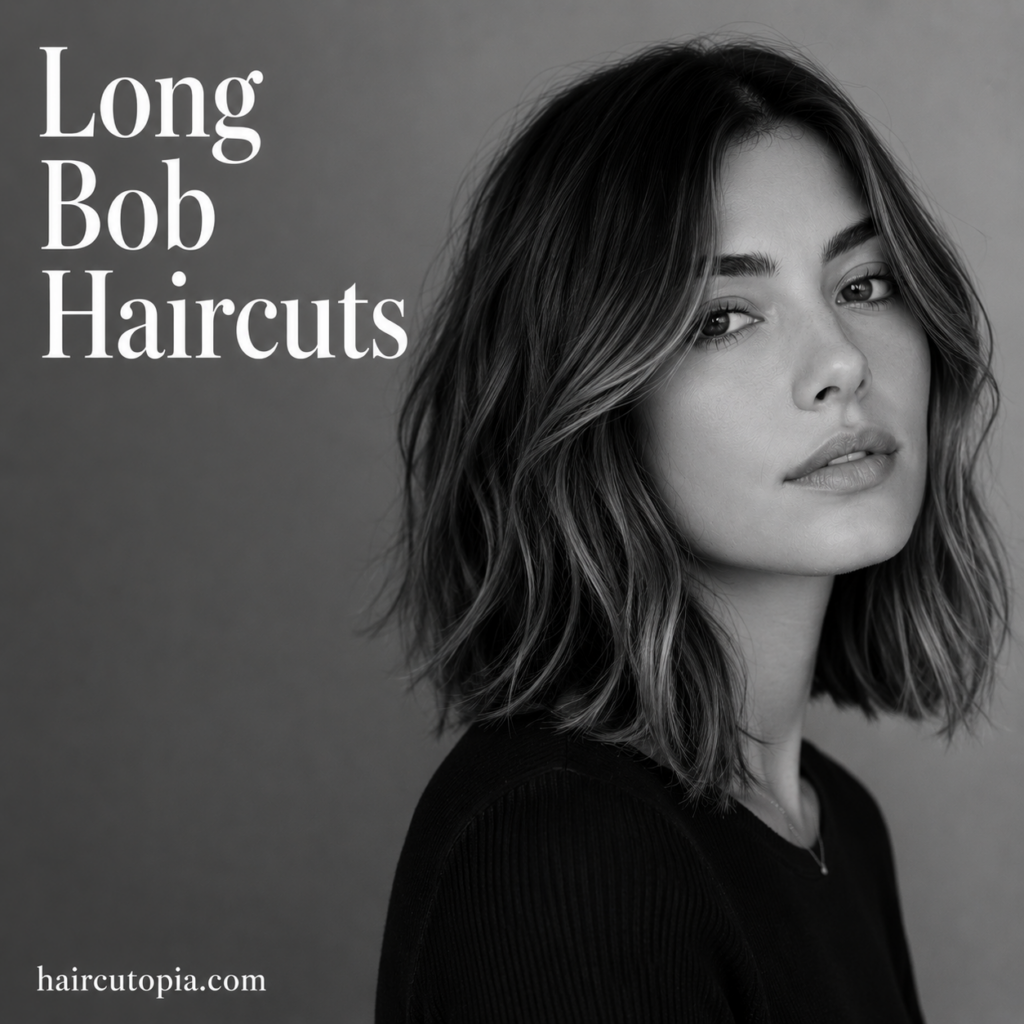
Long bob haircuts hit a sweet spot that shorter cuts and long hair don’t always reach. You get the clean, intentional shape of a bob without giving up quite as much length.
That extra few inches can make a surprisingly big difference.
A long bob can skim the shoulders, sit just above them, or fall closer to the collarbone. It can be blunt and polished, softly layered, textured and wavy, or shaped around natural curls. You can add bangs, face-framing pieces, an angled perimeter, or keep everything beautifully simple.
There’s also more styling flexibility than you get with a traditional short bob. Many long bobs can still be pulled into a ponytail, curled, straightened, tucked behind the ears, or worn naturally.
The key is choosing the right length and shape for your hair.
A cut that looks light and effortless on fine, straight hair may need completely different layering on thick waves or curls. Your face shape, density, natural texture, and everyday routine all influence the finished result.
If you’re considering a longer bob, here’s what to know before making the cut.
What Is a Long Bob Haircut?
A long bob is an extended version of the traditional bob haircut.
Instead of ending around the jaw or neck, the perimeter generally falls somewhere between the lower neck and collarbone.
Long bobs are often called lobs, and the terms frequently overlap. In everyday salon language, there’s no universally enforced boundary between the two.
Still, “long bob” is useful when describing a haircut that clearly retains the shape and structure of a bob while allowing additional length.
Common characteristics include:
- Length near the shoulders or collarbone
- A defined perimeter
- Minimal, moderate, or substantial layering
- Optional face-framing pieces
- Blunt or textured ends
- Straight, wavy, or curly finishes
- Enough length for more styling flexibility than a short bob
The overall silhouette matters more than an exact measurement.
Why Long Bob Haircuts Are So Popular
Among medium-length women’s haircuts, the long bob offers noticeable change without feeling overly drastic.
If you’ve had long hair for years, cutting directly to your jaw can feel like a huge commitment. Moving to shoulder or collarbone length creates a noticeable transformation while preserving some familiar length.
Long bobs are also versatile.
They can look sleek enough for a polished finish one day and relaxed with loose waves the next. Depending on the exact length, you may still be able to create ponytails, low buns, half-up styles, and other practical hairstyles.
Another advantage is how easily the basic cut can be customized.
You can change:
- The perimeter
- Layer placement
- Face framing
- Bangs
- Parting
- Texture
- Volume
- Styling
That makes the long bob less of a single haircut and more of a foundation that can be adapted to different hair types and personal styles.
Popular Types of Long Bob Haircuts
The length may be similar, but the cutting technique can create completely different results.
Here are some of the most common approaches.
Classic Long Bob
A classic long bob keeps the shape relatively simple.
The perimeter typically falls around the shoulders with limited visible layering.
This creates a clean silhouette that can be worn straight, wavy, or with natural texture.
It’s a particularly good starting point if you want something noticeably shorter than long hair without committing to a highly stylized cut.
Blunt Long Bob
The blunt long bob emphasizes the strong, defined perimeter associated with blunt cut haircuts while preserving the additional length of a longer bob.
Instead of obvious layers, the ends appear relatively even and substantial.
This can make the haircut look sleek and modern, particularly when worn straight.
A blunt perimeter can also be helpful for fine or lower-density hair because maintaining weight through the ends may create the appearance of greater fullness.
Blunt doesn’t have to mean rigid, though. Subtle internal shaping can keep the haircut moving while preserving the strong exterior line.
Layered Long Bob
Layers introduce more movement throughout a long bob.
They can be barely noticeable or become a major feature of the haircut.
Long, blended layers tend to preserve fullness while preventing the cut from feeling heavy. Shorter layers create more obvious volume and texture.
A layered long bob can be particularly useful for thick hair or anyone who wants a softer silhouette than a blunt cut provides.
Textured Long Bob
A longer take on the textured bob has a relaxed finish with more separation through the ends.
Rather than creating one perfect line, the cut encourages movement.
It works particularly well with natural waves, although straight hair can also be styled with loose bends to emphasize the texture.
The result often feels casual without looking unfinished.
Angled Long Bob
An angled long bob uses a silhouette similar to an A-line bob, with the hair cut slightly shorter toward the back and longer toward the front.
The difference can be subtle enough to simply create movement or dramatic enough to make the angle a defining feature.
A softer angle tends to be easier to grow out and style in different ways.
More dramatic angles create a stronger profile and put additional emphasis on the front sections.
Long Bob With Face-Framing Layers
Face-framing layers can give a long bob more shape without heavily layering the entire haircut.
The shortest pieces might begin around the cheekbones, jaw, chin, or lower.
This creates movement around the face while preserving fullness throughout the rest of the perimeter.
Face framing is particularly useful if a one-length long bob feels too heavy around the front.
Long Bob With Bangs
Adding bangs changes the balance of a long bob considerably.
Because the overall haircut has more length than a traditional bob, fringe can create a stronger focal point around the face.
Popular options include:
- Curtain bangs
- Wispy bangs
- Blunt bangs
- Side-swept bangs
- Bottleneck bangs
- Textured fringe
Longer bangs tend to blend easily into face-framing layers, while shorter fringe creates more contrast with the length of the haircut.
Long Bob vs. Short Bob
The biggest difference is obviously length, but that length affects more than appearance.
A short bob usually places the perimeter around the jaw, chin, or upper neck.
A long bob generally moves that perimeter toward the shoulders.
That changes styling flexibility.
With a long bob, you’re more likely to have enough hair for:
- Ponytails
- Low buns
- Half-up hairstyles
- Braids
- Claw clips
- More varied heat styling
Short bobs place greater emphasis on the jaw and neckline, while longer bobs tend to create a softer transition around the shoulders.
Salon maintenance may also differ.
Growth is often less noticeable on a longer bob because moving the perimeter down an inch doesn’t change the overall silhouette as dramatically as it would on a jaw-length cut.
Long Bob vs. Lob: Is There a Difference?
Long bob and lob are commonly used to describe essentially the same family of haircuts.
“Lob” is simply a shortened version of “long bob.”
In practice, however, people sometimes use long bob to describe a broader range of extended bob shapes, while lob is often associated specifically with shoulder-to-collarbone lengths.
There isn’t an official measurement separating them.
Instead of worrying too much about the name, focus on the details that actually affect the haircut:
- Exact length
- Perimeter shape
- Layering
- Texture
- Face framing
- Bangs
Showing your stylist where you want the hair to fall is much more useful than relying on terminology alone.
Choosing the Right Long Bob Length
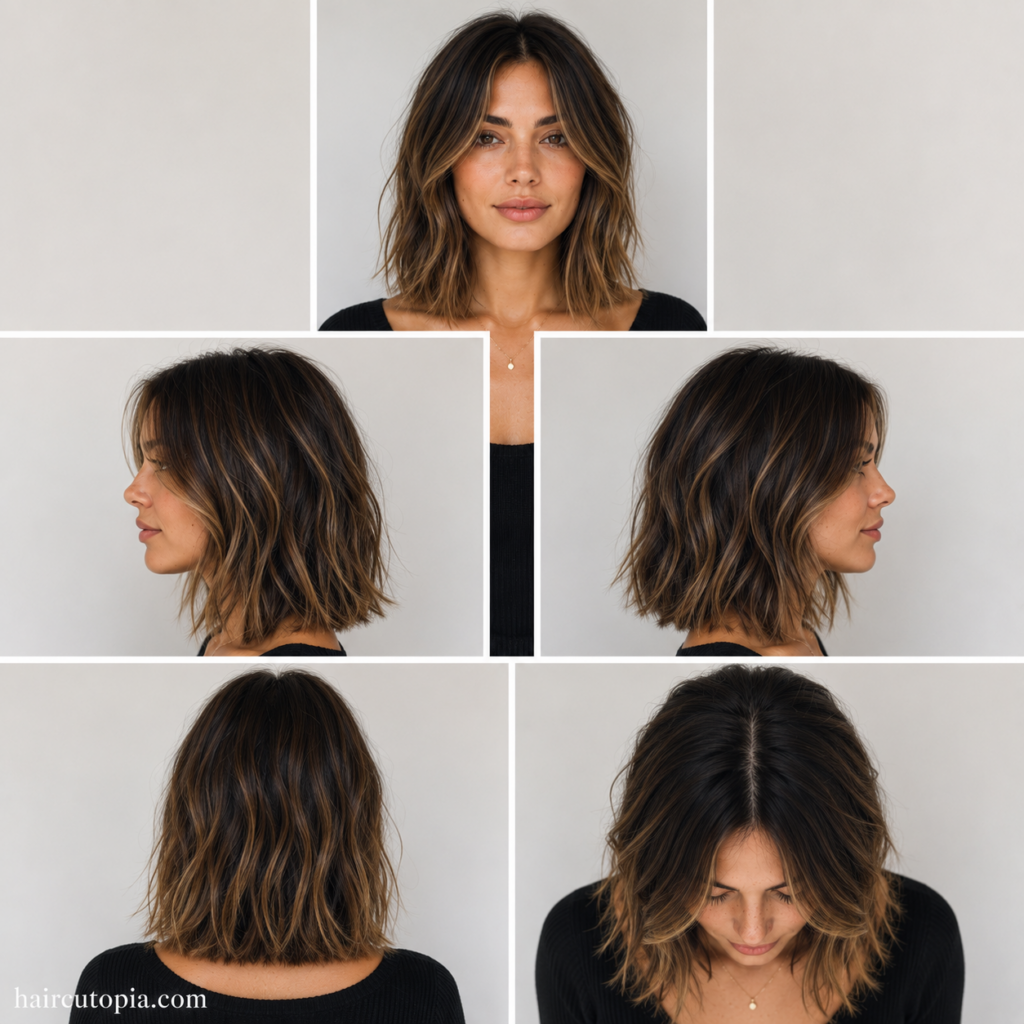
A couple of inches can determine whether your haircut feels short, medium, or somewhere in between.
Consider both appearance and practicality.
Above-the-Shoulder Long Bob
A long bob sitting just above the shoulders has a clearly defined perimeter and avoids some of the flipping that can happen when hair rests directly on the shoulders.
It still feels distinctly bob-like while providing more length than a jaw or neck-length cut.
Shoulder-Length Long Bob
Shoulder length offers a balanced middle ground.
The hair is long enough for more styling options but short enough to create a noticeable transformation from longer lengths.
One consideration is how the ends interact with your shoulders.
Depending on texture, they may naturally flip inward or outward.
Collarbone-Length Long Bob
A collarbone-length cut offers the most length within the long-bob family.
This can be a comfortable choice if you’re hesitant about going short.
It also provides plenty of room for layers, face framing, waves, and ponytails.
Because the perimeter falls below the shoulders, the hair may move more naturally without constantly resting against them.
Long Bob Haircuts for Fine Hair
Fine hair can benefit from the structure of a long bob.
Very long fine hair sometimes appears thinner toward the ends, especially if the perimeter has become tapered or damaged.
Removing some length can create a stronger baseline.
Styles worth considering include:
- Blunt long bobs
- One-length long bobs
- Softly angled cuts
- Lightly layered long bobs
- Long bobs with subtle face framing
Be selective with layering.
Too many short layers can remove valuable fullness from fine hair. Longer, subtle layers may provide movement without making the ends look sparse.
Styling products should generally remain lightweight.
Root-lifting sprays, light mousses, or volumizing products can add body without coating the strands too heavily.
Long Bob Haircuts for Thick Hair
Thick hair can make a long bob look full and substantial, but weight distribution becomes important.
A completely one-length cut may feel heavy, particularly around the perimeter.
Strategic layering can remove some bulk and create movement.
Good options include:
- Layered long bobs
- Textured long bobs
- Angled cuts
- Long bobs with internal shaping
- Face-framing layers
The goal isn’t necessarily to thin the hair aggressively.
Removing too much weight can cause certain textures to expand or become difficult to control.
A thoughtful cut preserves density while allowing the hair to move.
Long Bob Haircuts for Straight Hair
Straight hair naturally emphasizes the perimeter of a long bob.
That makes blunt and precision cuts particularly effective.
A sleek long bob can create a clean, minimalist look with very little visual clutter.
If you prefer movement, subtle layers or face-framing pieces can soften the silhouette.
Straight hair can also transition easily between different styling approaches.
Wear it smooth for a polished finish, add loose bends for texture, or tuck the front sections behind the ears for a simpler look.
Long Bob Haircuts for Wavy Hair
Wavy hair and long bobs work naturally together.
The length is short enough to remove some weight while still giving the waves room to develop.
Textured and layered versions can enhance that movement.
If you usually air-dry your hair, tell your stylist. The cut should be designed around how your waves naturally form rather than how they look after being straightened.
Remember that removing length can make waves spring upward slightly.
Your dry finished length may therefore be shorter than expected.
Long Bob Haircuts for Curly Hair
A long bob can provide curly hair with plenty of shape while retaining enough length for the curl pattern to develop.
Layers can distribute volume and prevent excessive weight toward the bottom.
Shrinkage remains an important consideration.
Curly hair may appear considerably shorter when dry, so the desired final length should be discussed in its natural state.
A curly long bob can be:
- Rounded
- Layered
- Voluminous
- Softly tapered
- Face-framed
- Worn with curly bangs
The right approach depends on curl pattern, density, and how much volume you prefer.
Long Bob Haircuts for Different Face Shapes
Face shape can help guide the details of your haircut, but it shouldn’t limit your choices.
Length, parting, bangs, and layers can all adjust the way a long bob frames the face.
Long Bobs for Oval Faces
Oval faces can generally wear a wide range of long-bob styles.
Blunt, layered, textured, angled, and bang-heavy versions are all possibilities.
Hair texture and personal preference can guide the final choice.
Long Bobs for Round Faces
Longer front sections and a perimeter falling below the chin can create vertical emphasis around a round face.
An angled long bob is one option.
Face-framing layers can also change how the haircut falls around the cheeks and jaw.
That said, you don’t have to choose a haircut specifically to make your face appear longer. A fuller, wavier long bob can be equally flattering if that’s the look you prefer.
Long Bobs for Square Faces
Soft waves and face-framing layers can contrast with a defined jawline.
If you prefer a stronger look, a blunt perimeter can instead emphasize facial structure.
A long bob gives you enough length to experiment with either direction.
Long Bobs for Heart-Shaped Faces
Shoulder and collarbone lengths can add movement around the lower portion of a heart-shaped face.
Curtain bangs and face-framing layers can further customize the balance.
Long Bobs for Long Faces
Shoulder-length cuts can create more horizontal emphasis than very long hair.
Waves, bangs, and side volume can strengthen that effect.
A blunt long bob can also provide a clean horizontal line around the shoulders.
Long Bob Haircuts With Bangs
Bangs are an easy way to change a long bob without removing additional overall length.
Long Bob With Curtain Bangs
Curtain bangs pair naturally with longer bobs.
The fringe can gradually blend into face-framing pieces, creating movement from the cheekbones through the ends.
They’re particularly effective with layered or wavy cuts.
Long Bob With Wispy Bangs
Wispy bangs add softness without creating a heavy block of fringe.
They can work well with fine hair and relaxed long-bob styles.
Long Bob With Blunt Bangs
Blunt bangs create stronger contrast.
Combined with a blunt perimeter, they can give the haircut a graphic, structured appearance.
This style may require more regular trimming to maintain the intended proportions.
Long Bob With Side-Swept Bangs
Side-swept fringe creates asymmetry and can blend easily into longer layers.
It also provides more flexibility if you decide to grow your bangs out later.
Blunt vs. Layered Long Bob Haircuts
The decision between blunt and layered comes down largely to the finish you want.
A blunt long bob tends to emphasize:
- Fullness
- Strong ends
- Clean lines
- Simplicity
- Structure
A layered long bob tends to emphasize:
- Movement
- Volume
- Texture
- Softness
- Flow
Fine hair may benefit from maintaining more perimeter weight.
Thick hair may benefit from carefully placed layers.
But there’s plenty of middle ground.
You can maintain a blunt-looking baseline while adding subtle internal layers that aren’t immediately visible.
Middle-Part Long Bob Haircuts
A middle part gives a long bob a balanced, symmetrical appearance.
It works particularly well with blunt cuts and face-framing layers.
The front sections can fall evenly on either side or sweep away from the face.
If your natural growth pattern strongly favors another part, however, forcing a perfect center may create unnecessary styling work.
A slightly off-center part can provide a similar effect.
Side-Part Long Bob Haircuts
A side part introduces more asymmetry and can create additional volume on one side.
It pairs particularly well with waves and layered cuts.
Changing your part is also one of the easiest ways to refresh a long bob without changing the actual haircut.
How to Style a Long Bob
The additional length makes long bobs highly adaptable.
Sleek and Straight
Smooth styling emphasizes the perimeter and overall shape.
This works especially well with blunt and angled long bobs.
Always use appropriate heat protection if you’re regularly using hot tools.
Loose Waves
Loose waves are one of the most popular ways to style a longer bob because they create movement without overwhelming the shape.
Avoid making every section identical if you want a more relaxed finish.
Natural Texture
If your hair already has waves or curls, allowing that texture to form naturally can simplify your routine.
Choose products that support your existing pattern rather than weighing it down.
Textured Ends
A small amount of styling product through the mid-lengths and ends can create separation.
Start lightly. You can always add more.
Half-Up Styles
Long bobs usually provide enough length for simple half-up hairstyles.
This can be particularly useful when growing out bangs or face-framing pieces.
Low Ponytail
Depending on the exact length, many long bobs can fit into a low ponytail.
If this is important to you, mention it before your haircut so the front sections aren’t cut too short to reach the elastic.
Are Long Bob Haircuts Low Maintenance?
Long bobs can be relatively manageable, particularly compared with precision short cuts.
The extra length makes growth less immediately noticeable.
You may also have more options on days when you don’t want to style your hair because it can often be tied back.
However, maintenance still depends on the specific cut.
Blunt precision styles may need regular trims to keep the perimeter sharp.
Bangs can require separate upkeep.
A heavily styled look may also involve more daily work than an air-dried textured cut.
Choose the version that matches your actual routine rather than the routine you imagine having after leaving the salon.
How Often Should You Trim a Long Bob?
Many long bobs can be maintained with trims approximately every 8–12 weeks.
A particularly sharp blunt cut may need attention sooner, while a softer layered style may grow out comfortably for longer.
Your schedule will depend on:
- Hair growth rate
- Condition of the ends
- Bangs
- Layering
- Desired length
- How precise you want the perimeter
If you’re actively growing the haircut longer, trims can be lighter and less frequent.
How to Ask Your Stylist for a Long Bob
Don’t rely entirely on the phrase “long bob.”
Show exactly where you want the perimeter to fall.
Bring reference photos and explain which details matter most.
Discuss:
- Your desired finished length.
- Whether the hair should sit above, at, or below the shoulders.
- Whether you want a blunt or soft perimeter.
- How much layering you want.
- Whether you want face-framing pieces.
- Whether you’re adding bangs.
- How you normally style your hair.
- Whether you need to put it into a ponytail.
Also tell your stylist how much effort you’re willing to put into daily styling.
That can influence the cutting approach considerably.
Transitioning From Long Hair to a Long Bob
A long bob is one of the easiest ways to experiment with shorter hair without making an extreme change.
If your hair currently falls well below your shoulders, the difference will still be noticeable.
You’ll remove a substantial amount of length while preserving enough hair to maintain styling flexibility.
You may also notice your natural texture changing.
Waves and curls can become more pronounced once excess weight is removed.
If you’re considering an even shorter bob eventually, living with a long bob first can help you decide whether you enjoy shorter proportions before moving the perimeter toward the chin or jaw.
Growing Out a Long Bob
Growing out a long bob is usually straightforward.
Because the haircut is already close to medium length, the transition into longer hair can happen without dramatic awkward stages.
You may want occasional trims to maintain the condition of the ends and gradually adjust any shorter layers.
If you’re growing out an angled long bob, the back may need time to catch up with the longer front sections.
Tell your stylist about your goal so trims focus on reshaping rather than repeatedly returning the cut to its original length.
Who Should Consider a Long Bob?
A long bob can be a particularly good option if you:
- Want to cut long hair without going dramatically short
- Prefer enough length for a ponytail
- Want a defined haircut rather than shapeless medium hair
- Like both straight and wavy styling
- Want to remove damaged ends
- Need more movement in thick hair
- Want fine hair to appear fuller at the perimeter
- Are considering a shorter bob in the future
- Prefer a haircut that can grow out relatively easily
It’s one of those rare cuts that can feel like a major change without taking away most of your styling flexibility.
Frequently Asked Questions About Long Bob Haircuts
What length is a long bob?
A long bob generally falls somewhere between the lower neck and collarbone, with shoulder-length versions being especially common.
Is a long bob the same as a lob?
The terms are often used interchangeably. Lob is simply short for long bob, although people may use the names slightly differently when describing exact lengths.
Can you put a long bob in a ponytail?
Usually, yes, particularly when the haircut reaches the shoulders or collarbone.
Short face-framing pieces or bangs may not reach the ponytail.
Do long bobs make fine hair look thicker?
A strong perimeter can help the ends of fine hair appear fuller, particularly when excessive layering is avoided.
Are long bobs good for thick hair?
Yes. Layers or internal shaping can remove excess weight while preserving the overall long-bob silhouette.
Can curly hair have a long bob?
Absolutely.
A long bob can give curls shape while retaining enough length for the curl pattern to develop. Shrinkage should be considered when choosing the final length.
What is the easiest long bob to maintain?
A cut designed around your natural texture will generally require the least daily styling.
Soft, lightly layered or textured long bobs can also grow out more forgivingly than highly precise shapes.
How often should a long bob be trimmed?
Approximately every 8–12 weeks works for many long bobs, although precise cuts or damaged ends may require more frequent attention.
Is a long bob easier to maintain than a short bob?
It can be.
Growth is less immediately noticeable, and the additional length often allows you to tie the hair back. However, daily maintenance ultimately depends on the style and your natural texture.
Can you wear bangs with a long bob?
Yes. Curtain, wispy, blunt, side-swept, and textured bangs can all be paired with longer bobs.
Final Thoughts on Long Bob Haircuts
The long bob works because it doesn’t force you to choose between short and long hair.
It gives you some of both.
You get the stronger perimeter and intentional shape associated with a bob while keeping enough length for waves, ponytails, face-framing layers, and different styling options.
From there, the details make the haircut personal.
Keep it blunt if you love clean lines. Add layers if you want movement. Introduce face-framing pieces for softness, bangs for a bigger change, or texture for a more relaxed finish.
Most importantly, choose the length based on how you actually use your hair.
If tying it back matters, preserve enough length. If you want a more dramatic transformation, move the perimeter higher. If you’re unsure about shorter hair, start around the collarbone and see how it feels.
A good long bob doesn’t need to be complicated. It simply needs the right proportions for your hair, your routine, and the way you want to wear it.